Xavier De Kestelier

IAAC Lecture Series – Xavier De Kestelier

Xavier De Kestelier is a global Head of Design and leader of Hassell‘s design technology and innovation team, which sets strategy and advises on the tools and knowledge we need to succeed. Both an architect and technologist, Xavier harnesses technology to create more powerful, future-focused design solutions. That means he’s responsible for overseeing Hassell’s work in computational design, building information modelling, visualisation and virtual reality worldwide.

Over the past decade he’s forged a reputation as an industry leader in the exploration and adoption of parametric design and digital fabrication. Prior to working at Hassell, Xavier spent 16 years at Foster + Partners, working as a Partner for the Specialist Modelling Group. Most recently, he was behind our concept for a ​‘home’ on Mars – part of NASA’s 3DPrinted Habitat Challenge. A TED talker and regular speaker at major design and tech events, Xavier is also a director of Smartgeometry, a non-profit, global educational network for computational and digital design specialists.

Additive Manufacturing in Extreme Environments, From Bidi Bidi to Valles Marineras

Additive Manufacturing, or 3D Printing, was pioneered over 30 years ago and has since become a commonplace tool in high-end manufacturing processes spanning from bicycles to rocket engines. Nevertheless, its application within the realm of architecture is still in its nascent stage. To this end, the Innovation team at Hassell studio has been undertaking multiple small projects with the aim of exploiting Additive Manufacturing for sustainable and innovative utilization. In order to gain an in-depth comprehension of 3D printing’s potential applications, projects have been conducted across various climates: from Swiss glaciers to East African refugee camps as well as at Vales Marineras on Mars.

IAAC Lecture Series – Xavier De Kestelier

Thursday, 23rd February, 2023 at 19.30h (CET)

Title: “Additive Manufacturing in Extreme Environments, From Bidi Bidi to Valles Marineras”

Location: In-house at IAAC Main hall, C/ Pujades 102 & Zoom

REGISTER

Redes, Palabras Cruzadas en Iberoamérica

Redes | Palabras Cruzadas en Iberoamérica – Sesión Especial “Imaginarios de lo Urbano: Barcelona vs Buenos Aires”

El próximo lunes 20 de febrero 2023 a las 19:00 hrs CET, ¡mira la Sesión Especial de Redes | Palabras Cruzadas en Iberoamérica!

En esta ocasión el título de la sesión será: “Imaginarios de lo Urbano: Barcelona vs Buenos Aires”, con una conversación con Xavier Matilla & Alvaro Garcia Resta, moderado por Mariano Gomez Luque.

blank

Xavier Matilla, Arquitecto jefe del Ayuntamiento de Barcelona

Arquitecto-urbanista por la ETSAV-UPC, Arquitecto en Jefe del Ayuntamiento de Barcelona. Su trayectoria profesional y académica se ha focalizado en el urbanismo, y se caracteriza por su compromiso para avanzar hacia ciudades y territorios más saludables y justos. Ha desarrollado su carrera profesional en diferentes despachos de reconocido prestigio. El año 2013 fundó con la arquitecta Mónica Beguer el despacho «Territorios XLM», dedicado a la planificación territorial estratégica, proyectos urbanos y proyectos de espacio público. Es profesor asociado del Departamento de Urbanismo y Ordenación del Territorio (DUOT) de la Universidad Politécnica de Cataluña UPC_BarcelonaTECH y profesor del «Master Metrópoli en Estudios Metropolitanos y Urbanos del IERMB y la UAB. Es autor de diversas publicaciones sobre planificación urbana y diseño del espacio público. Entre los años 2010 y 2015 fue secretario de la Agrupación de Arquitectos Urbanistas de Cataluña y concejal del Ayuntamiento de Terrassa 2015 a 2019.

Alvaro Garcia Resta, Secretario de desarrollo urbano de la ciudad de Buenos Aires

Urbanista y Arquitecto (Universidad de Palermo), líder para la innovación en el desarrollo urbano sostenible (Escuela de Diseño, Universidad de Harvard), miembro permanente del Jury de la Escuela de Arquitectura (Universidad de Illinois) y visitor fellow del Observatorio de América Latina (The New School). Actualmente es el Director del posgrado de Diseño Urbano Antropológico (Facultad de Arquitectura, Diseño y Urbanismo de la Universidad de Buenos Aires), del Programa Ejecutivo Diseño Antropológico Urbano (Facultad de Arquitectura de la Universidad de Palermo), de la Diplomatura en Antropología Urbana (Facultad de Arquitectura y Diseño de la Universidad Argentina de la Empresa) y Profesor Adjunto a cargo de Proyecto Urbano en la Cátedra Solsona Ledesma del último Nivel de la materia vertical Arquitectura (Facultad de Arquitectura, Diseño y Urbanismo de la Universidad de Buenos Aires).

Moderador: Mariano Gomez Luque

Mariano Gomez Luque es el director del Urban Sciences Lab del IAAC, codirector de FORMA, una oficina de arquitectura general con sede en Córdoba (Argentina), e investigador afiliado del Urban Theory Lab de la Universidad de Chicago. Su investigación explora las intersecciones entre las disciplinas del diseño, la teoría urbana crítica y los estudios de ciencia ficción, con énfasis en el estatus y el potencial de la producción arquitectónica en condiciones de urbanización planetaria. Mariano es Doctor en Diseño (2019) y Máster en Arquitectura (2013) por Harvard GSD.
Directores de Redes: Willy Müller y Ariadna Cantís.

Fecha: Lunes, 20 de febrero 2023 19:00h CET

REGISTRO

Philip F. Yuan Lecture

“Nonlocal Locality” lecture by Philip F. Yuan Tuestday 14th February at IAAC Lecture Series

Philip F. Yuan is a professor at the College of Architecture and Urban Planning at Tongji University, Thomas Jefferson professor at University of Virginia (2019), the visiting professor at Massachusetts Institute of Technology (2019), and Royal Melbourne Institute of Technology (2021). He is also the co-founder of DigitalFUTURES Association, Editor-in-Chief of Architectural Intelligence journal, and council member of UIA Professional Practice Commission (PPC).
Yuan is a pioneer in architectural intelligence and robotic fabrication, making achievements in both academic research and architectural practice. He emphasizes the integration of technological innovation and architectural culture, building environment and ethics, constantly seeking human-machine collaboration in the era of post-humanism.

blank
Nonlocal Locality

Living in the era when the subject-object relationship of architectural design needs to be re-pondered and reassembled, we are establishing a global platform for international collaborations in order to promote discussion about a broad range of contemporary issues such as global ethics and technologies integrated with local culture within our ever evolving, highly technological culture. Facing global warming, geopolitical upheaval and the pandemic, while confronting the challenge of the mutual development of architecture and society, we need to redefine and rethink the relationship between globalization and locality to reflect the contradictions and the opportunities brought by the current trend of human-machine collaboration. Meanwhile, nonlocality describes the manner in which a hyperobject becomes more substantial than the local manifestations they produce.

IAAC Lecture Series – Philip F. Yuan

Date: Tuesday, 14th February, 2023 at 13.00h (CET)

Title: “Nonlocal Locality”

Location: Online (Zoom & Facebook)

REGISTER

Redes. Palabras Cruzadas en Iberoamérica

Redes, palabras cruzadas en Iberoamérica, es una iniciativa para generar diálogos online entre referentes del entorno iberoamericano de la arquitectura, diseño, urbanismo, sostenibilidad y otros temas cruciales para la sociedad actual.

El Martes 10 de enero 2023 únete a la Sesión 17 de Redes | Palabras Cruzadas en Iberoamérica. En esta ocasión el título de la sesión será: “Urbanización Postcapitalista”, con una conferencia de Daniel Daou y un diálogo entre él y Mariano Gomez Luque.

blank

Invitado: Daniel Daou

Daniel Daou (Líbano, 1982) es doctor en diseño por la escuela superior de diseño de la Universidad de Harvard, y tiene dos maestrías por el Instituto Tecnológico de Massachusetts – una en planeación urbana y una en ciencias de los estudios de la arquitectura con certificado en diseño urbano. Obtuvo su licenciatura en arquitectura y urbanismo en la Universidad Iberoamericana en 2006 donde se graduó con mención honorífica y excelencia académica. Actualmente es miembro del Sistema Nacional de Creadores del Arte del Fondo Nacional para la Cultura y las Artes, profesor asociado de la Facultad de Arquitectura de la Universidad Nacional Autónoma de México adscrito al Laboratorio de Entornos Sostenibles y miembro del consejo editorial de Editorial Arquine. Sus intereses giran en torno a las ideas de postcapitalismo y el diseño planetario.

Modera: Mariano Gomez Luque

Mariano Gomez Luque es el director del Urban Sciences Lab del IAAC, codirector de FORMA, una oficina de arquitectura general con sede en Córdoba (Argentina), e investigador afiliado del Urban Theory Lab de la Universidad de Chicago. Su investigación explora las intersecciones entre las disciplinas del diseño, la teoría urbana crítica y los estudios de ciencia ficción, con énfasis en el estatus y el potencial de la producción arquitectónica en condiciones de urbanización planetaria. Mariano es Doctor en Diseño (2019) y Máster en Arquitectura (2013) por Harvard GSD.

MORE

Andreina Seijas at IAAC

Andreina Seijas is a Venezuelan researcher and international consultant. After completing her doctoral studies in night-time planning and governance at the Harvard School of Design, Andreina founded Night Tank, a firm specialized in this novel field. Previously, Andreina worked as a senior consultant for IdenCity in Barcelona; as consultant for the Housing and Urban Development Division at the Inter-American Development Bank (IDB) in Washington D.C.; as Policy Associate at the Council of the Americas in New York City; and as Information Manager for the municipality of Chacao in Caracas, Venezuela. Andreina has a Communications degree from Universidad Catolica Andres Bello, an MSc in Social Policy and Development from the London School of Economics, a Master in Public Administration and Non-Profit management from New York University, and a Doctor of Design (DDes) degree from the Harvard Graduate School of Design.

blank
Managing 24-Hour Cities: Time as a New Urban Frontier by Andreina Seijas

Time, like space, is a key asset in urban areas. However, urbanists often forget about the social and political implications of managing urban time. A public space, a square or a building has different uses throughout the 24-hour cycle, and a wide range of actors take part in the nocturnal ecosystem of cities: nightlife and entertainment venues, hospitals, transport and logistics, call centers and creative industries, just to name a few, are part of cities’ night-time economy. While vibrant nightscapes have become a mark for the cultural status and appeal of global cities, sensitivities to noise and other forms of nuisance become greater after dark. To handle this, more than 60 cities around the world have created specialized institutions such as “night mayors,” responsible for mediating among public and private interests and promoting safe and inclusive nocturnal environments. By presenting international projects and examples, this talk will introduce the concept of night-time governance and explain why the urban night is becoming a relevant field of study and practice within the planning and design disciplines.

IAAC Lecture Series – Andreina Seijas. Date: Thursday, 15th December, 2022 Time: 19.30h (CET)

Title: “Governing 24-Hour Cities: Time as a New Urban Frontier”

Location: In-house at IAAC Main hall, C/ Pujades 102 & Zoom

REGISTER

Mette Bak-Andersen at IAAC Lecture Series

“Sustainable Design – From Knowing About to Knowing How” lecture by Mette Bak-Andersen

Mette Bak-Andersen is a designer and researcher dedicated to changing the way we design things. She has a PhD in sustainable design and materials from the Royal Danish Academy of Architecture and Design and for more than 13 years she has been working with sustainability and material circularity in her design practice, in design education and in her research, both in Denmark and internationally. In 2013 she founded the Material Design Lab at Copenhagen School of Design & Technology, which she directed until 2018.

Mette has extensive experience with the design and production of furniture, products and interiors and has presented her research and designs to variety of audiences such as Berkeley University, Salone in Milan, Trapholt Museum of Design and Red Dot Museum in Essen. She has worked with a number of different companies as a design consultant supporting them in the transition to sustainable design and production. In 2021 she published the book Reintroducing Materials for Sustainable Design.

blank
Sustainable Design – From Knowing About to Knowing How

For too long humanity has been behaving as if the materials we could grow and extract from Earth were unlimited. This behaviour has affected how we have built our society and infrastructure, how we have processed raw materials, the setup of our manufacturing systems and not least, the way we design things.
For a period in time designers did not need to have much more knowledge about materials than anybody else. Because it did not matter how different materials were mixed and combined. We believed all resources to be abundant and did not need to recycle the materials from the products once they could no longer be used.

Many designers are by now fully aware of the urgency for change. They know about the criteria for sustainable design and want to take back control over their products, but frequently they are challenged by the fact that knowing about sustainable design is not the same as knowing how.
In-depth material knowledge, craft skills and the ability to manipulate and work with materials creatively may not seem directly related to sustainability, but they are essential attributes for a anyone who wish to design physical sustainable products. Even when the end goal is digital design and manufacturing.

This lecture is about why and how we must obtain this knowledge as designers and how the role of the designer inevitably will change in the process.

IAAC Lecture Series – Mette Bak-Andersen

Date: Tuesday, 22nd November, 2022 Time: 19.30h (CET)

Title: “Sustainable Design – From Knowing About to Knowing How”

Location: In-house at IAAC Main hall, C/ Pujades 102 & Zoom

REGISTER

Florencia Rodriguez at IAAC

“Why Bother? A Critical/Editorial Manifesto in the Age of Dispersion” by Florencia Rodriguez at IAAC Lecture Series

Florencia Rodriguez (January 29, 1975) is an Argentinian architect and cultural producer currently based in Brookline, MA.

Having practiced mainly as an editor, writer, and curator, she has built a unique career path driven by a strong entrepreneurial spirit that led her to create and run cultural initiatives related to architecture and design, both in Argentina and the US.

blank

In 2010, Rodriguez founded PLOT, an ongoing design publication that she continued to direct until 2017. Under her stewardship, it became one of the leading publications in Latin America.

Since early 2017 she embarked on a new endeavor and created Lots of architecture -publishers, a US-based publishing company focused on design, architecture and urban culture. Its most significant project has been the periodical publication -NESS. From that platform, she has edited books and organized events and activities committed to the dissemination of new narratives, the exploration of alternative forms of design criticism, and discussions about the role of design.

In 2015 she created Monte where she curated and promoted a very active and independent public program. Because of her persistent cultural engagement, she was also invited to act as a consultant for the City of Buenos Aires.

She has been teaching for more than two decades. Currently, she is a lecturer in architecture at the Harvard Graduate School of Design, where she was granted the Loeb Fellowship between 2013 and 2014.

Rodriguez has lectured, curated exhibitions, acted as juror, and organized international symposia in different institutions, principally in the Americas. She has received awards for her editorial work and published several articles in books and specialized media such as Domus, Oris, summa +, Arquine, a+u, or Uncube. She has recently co-edited America, the 48th issue of the Harvard Design Magazine, together with Mark Lee.

She is launching 3 new books in 2022. The first one, MCHAP 2 Territory & Expeditions, is being printed this month.

IAAC Lecture Series – Florencia Rodriguez “Why Bother? A Critical/Editorial Manifesto in the Age of Dispersion”

Date: May 31st , 2022 at 19.30h (CEST)

Location: Online Zoom Event

MORE

Afrikan Ecological Architecture Symposium

IAAC presents Afrikan Ecological Architecture Symposium

By 2050, Africa’s cities will be home to an additional 950 million people. The Afrikan Ecological Architecture Symposium event brings together various African designers, architects, engineers, and other professionals using homegrown solutions to address this unique nexus of opportunities and challenges, using solutions that tie together innovation, technology and craft, while elevating the vernacular.

blank

The Afrikan Ecological Architecture Symposium is aimed at providing a platform for young architects and designers from the continent to showcase their work and also for more seasoned professionals to come together in the hopes of tackling pertinent issues affecting Africa’s design and build sector. The topics to be covered are: integrating nature and culture with design, new age materiality, re-thinking design education on the continent, the role of digital design and fabrication in the future of the continent, public space, and Afro-Futurism.

The event will be held online on May 27th, 2022 and include a keynote lecture by Stella Mutegi and Kabage Karanja of Cave Bureau, in addition to roundtable discussions featuring names such as Christian Benimana (Senior Principal and Managing Director of MASS Design Group) and industrial and furniture designer, Jomo Tariku.

blank

IAAC is glad to announce that the event, organized by IAAC Valldaura Labs in collaboration with the African Design Centre, will be moderated by students coming from 3DPAMAEBB, and MAA educational programmes.

The speakers:
Stella Mutegi, Kabage Karanja, Joelle Eyeson, Mtamu Kililo, Franc Kamugyisha, Christian Benimana, Killion Mokwete, Jomo Tariku, Issa Diabaté, Dr. Marwa, Dabaieh, Sénamé Koffi Agbodjinou, Sitou Akolly, Samenjo Tondo, Mokena Makeka, Sylvia Makario, Dr. Mark Olweny, Lawretta Egba, Zubaydah Jibrilu.

MORE

Lindsay Bremner at IAAC Lecture Series

Lindsay Bremner: Monsoon as Method

This lecture by Lindsay Bremner is part of the preparation for the global online competition “Design for Biocities.” This is the 9th edition of the Advanced Architecture Contest, this time focused on rethinking our human habitats following the rules of natural systems, promoting the transition from Cities to Biocities.

blank
Lindsay Bremner

Dr. Lindsay Bremner is a research architect and educator at the University of Westminster in London where she is Director of Research in the School of Architecture and Cities. She recently (2016-2021) held European Research Council grant no. 679873 for Monsoon Assemblages, a project exploring three Bay of Bengal cities – Chennai, Dhaka and Yangon, as monsoonal assemblages are being disrupted and transformed by globalisation and climate change. She holds a B.Arch from the University of Cape Town and an M.Arch and DSc.Arch from the University of the Witwatersrand, Johannesburg.

Lecture Abstract:

This presentation arises out of the work of Monsoon Assemblages, a research project funded by the European Research Council from 2016-2021. The presentation will think through what it means to reframe spatial research around the monsoon, a weather system that envelopes the globe, and to approach cities as monsoon assemblages or weather worlds. It will thus challenge ways of thinking of cities and climate or society and nature as separate entities stacked up against one another, and instead explore the multiple ways they are entangled and co produced.

IAAC Lecture Series – Lindsay Bremner: Monsoon as Method

Thursday, April 7th  18:00 CEST

Event: “Design for Biocities” 9th Advanced Architecture Contest

Location: Online Zoom

Free registration here

Winy Maas at IAAC Lectures

Every(body) is Urbanism Lecture by Winy Maas

The next lecturer at IAAC is Winy Maas with “Every(body) is urbanism”, a talk about the intersection of nature, urbanism, architecture and the human body. A series of pioneer ideas for variety of ‘ecosystems’ will be explored, including calculations and visualizations of a versatile mix of fashion, heritage, urbanism and biodiversity.

blank
About Winy Maas

The ‘M’ of MVRDV, Founding Partner and Principal Architect Winy Maas Ir. Ing (Schijndel, NL – 1959), has received international acclaim for his broad range of urban planning and building projects, across all typologies and scales. These are often self-generated, innovative, experimental, and theoretical. Maas challenges colleagues, clients, as well as students and collaborators at TU Delft’s The Why Factory – an internationally engaged think tank Maas established in 2008 – to challenge the boundaries of established standards to produce solutions that reimagine how we live, work, and play. Aside from his dedicated leadership role at MVRDV and professorship at TU Delft and elsewhere, Maas is widely published, actively engaged in the advancement of the design profession, and sits on numerous boards and juries, including the Spatial Quality Boards of Rotterdam, Eindhoven, and Barcelona.

“I advocate denser, greener, more attractive and livable cities, with an approach to design that centres around user-defined, innovative, and sustainable ideas for the built environment, regardless of typology or scale.” – Winy Maas.

In the past Maas has been a visiting professor and has held various teaching positions at notable institutes including the Architectural Association School of Architecture in London, Massachusetts Institute of Technology, Yale University, Columbia University in New York, the Strelka Institute in Moscow, Hong Kong University, and the Rotterdam Building Academy.

With The Why Factory he has published more than thirteen books on The Future City, including Green Dream (2010), Copy Paste (2017), and Porocity (2018). He has written and published several books on the theories behind MVRDV, like Farmax: Excursions on Density (1997) together with co-founder Jacob van Rijs; KM3: Excursions on Capacities (2005), Five Minutes City (2003), and Skycar City (2007).

Date: Monday, February 14th Time: 19:30 CET

Title: Every(body) is Urbanism

Location: In-house at IAAC Main hall & Zoom

MORE

Stefano Boeri, IAAC Lecture Series

IAAC Lecture Series: Green Obsession by Stefano Boeri

This lecture by acclaimed Italian architect Stefano Boeri is the launching event for the global online competition “Design for Biocities.” This is the 9th edition of the Advanced Architecture Contest, this time focused on rethinking our human habitats following the rules of natural systems, promoting the transition from Cities to Biocities.

blank

Lecture Abstract:

Today the effects of the Anthropocene age are ever more visible, changing our environment and affecting every species that lives within it. Green Obsession offers a path to be taken, a hard but still necessary paradigm shift – even for architecture and urbanism – that aims to give a voice to this much needed ecological transition. A book with the same title, recently published by Actar, aims to unveil the processes and the complexity involved in the search for a new kind of urbanism, while raising questions and opening old wounds related to the relationship between the human species and Nature and finally putting these fragments together to create a portrait of our era. We need to conceive cities as new green catalysts. Now more than ever, it is essential to act together as separate individuals and professionals, joining the cause as members of the global community with a shared environmental strategy. We all have to open the era of a new alliance between Nature and City.

blank

Liuzhou Forest City by Stefano Boeri Architetti

About Stefano Boeri

Stefano Boeri is an architect and urban planner and Full Professor at Politecnico di Milano. In Shanghai he is Director of the Future City Lab at Tongji University: a post-doctoral research program which explores the future of contemporary metropolis under the perspectives of biodiversity and urban forestry. Boeri’s practice ranges from the design of architecture and urban visions to product design, with a constant focus on the geopolitical and environmental implications of urban phenomena. One of his most highly cited projects is the Bosco Verticale in Milan.

IAAC Lecture Series – Stefano Boeri

Date: Tusday January 11th, 2022
Time: 19:30 CET

Title: Green Obsession
Event: Launching “Design for Biocities” 9th Advanced Architecture Contest

Location: Online Zoom/Facebook Live

The lecture is now fully booked. But you can follow the lecture live via Zoom or on IAAC’s Facebook. 

Cobus Bothma at IAAC Lecture Series

IAAC Lecture Series – Virtualising Architecture – Global collaborative design at KPF

30th November at iaac lecture series Cobus Bothma with the lecture “Virtualising  Architecture”, with the democratisation of technology and advanced functions in many industries, computational tasks in architectural design have remained in the hands of a few super users until recent years. The KPF (Kohn Pedersen Fox) Advanced Technology Group is developing intuitive design processes for distributed location-independent design, with enhanced levels of immersion, enabling more designers to perform higher-level functions required by the modern design process. This presentation will show how we develop and adopt remote geometry, and visual compute tools and expand our global infrastructure to continue delivering award-winning architectural designs.

blank

About Cobus Bothma

With a background in industrial design, Cobus brings over 30 years’ experience in architectural and product design from across multiple industries. As a director at KPF, Cobus is involved in many aspects of advanced design, visualisation, complex geometry and fabrication. Through KPF Applied Research, he applies computational, cognitive, and visual design workflows to enhance the design, review and fabrication processes internally and for their clients.

blank

Cobus has led KPF’s partnerships with some of the world’s leading technology companies. His work with these companies includes developing, testing and implementing new hardware, applications and workflows. This work continues to grow KPF’s design capabilities globally, to improve the buildings and cities we design and enhance the lives of the people who use them. It is also shaping the direction of the broader development of the AEC industry. A recognised authority in the field, Cobus is a frequent speaker at academic institutions and leading cross-industry technology events on advanced geometry and visual computation.

Lecturer: Cobus Bothma

Date: Tuesday, November 30th, 2021 at 9:30 CET

Location: IAAC – Pujades 102, Poble Nou, Barcelona

Responsive Cities Symposium 2021

RESPONSIVE CITIES SYMPOSIUM 2021: DESIGN WITH NATURE

The Institute for Advanced Architecture of Catalonia (IAAC) is conducting the final symposium of the BUILD Solutions Project in Barcelona to be held from the 11th-12th November 2021. Responsive Cities is a bi-annual international symposium on the future of cities organized by the Advanced Architecture Group of IAAC.

blank

The 2021 edition focuses on “Design with Nature” and takes place within the framework of the Building Urban Intelligent Living Design Solutions (BUILDs) project, co-funded by the Erasmus+ Programme of the European Union and developed by the Institute for Advanced Architecture of Catalonia – IAAC- (Spain), Université de Lorraine -UL- (France), Vienna University of Economics and Business -WU- (Austria), Ersilia Foundation (Spain), ECONICK (France), Plant-e (Netherlands), City Facilitators -CF- (Denmark), and GreenTech Challenge -GTC- (Denmark).

Despite cities having strengthened their economy, efficiency, and liveability over the last decades, they are still facing major issues such as pollution, rising inequities, and unemployment. These already harmful conditions are furthermore aggravated by catastrophic events such as the current pandemic. New planning paradigms that recognize the importance of ecology to respond to these challenges are being developed, by integrating living systems in urban environments aimed at improving cities’ socio-economic and environmental conditions.
Living systems integrated in cities are also known as Nature-Based Solutions (NBS), defined as “living solutions inspired by, continuously supported by, and using nature, which are designed to address various societal challenges in a resource efficient and adaptable manner and to provide simultaneously economic, social, and environmental benefits” (European Commission, 2015). NBS can help address several challenges through the provision of multiple ecosystem services such as life support (soil formation and oxygen production); procurement (production of food, drinking water, raw materials or fuel); regulation (climate control and tidal waves, water purification, pollination); and cultural values, including the aesthetic, educational, and recreational values. Design-optimized strategies can help reintegrate nature in cities by transforming urban spaces into liveable, productive, and biodiverse systems.

blank

MORE

Anupama Kundoo at IAAC Lecture Series

Slow Architecture with Anupama Kundoo

Anupama Kundoo discusses the potential of architecture to address complex intersections of urbanization, people, technologies, resources, and the environment within the context of growing affordability issues. Her practice, the result of her quest for knowledge to build appropriately, considers projects as opportunities to build knowledge. Architecture is the result of building processes, and time needs to be invested despite the sense of urgency triggered by rapid urbanization.

blank

About the lecturer

Anupama Kundoo graduated from University of Mumbai in 1989 and received her PhD degree from the TU Berlin in 2008. Her research-oriented practice has generated people centric architecture based on spatial and material research for low environmental impact while being socio-economically beneficial. Her body of works is currently exhibited as a solo show ‘Taking Time’ at Louisiana Museum of Modern Art, Denmark till 5. April 2021.

She has taught Architecture and Urban Management at various international universities strengthening her expertise in rapid urbanization and climate change related development issues, and was the Davenport Visiting Professor at Yale University in Spring 2020. She is currently Professor at Potsdam School of Architecture, Germany.

This lecture will be an online event, hosted with Zoom. 

IAAC Lecture Series – Slow Architecture

Lecturer: Anupama Kundoo 

Date: Thursday, February 18th, 19:30 (CET)

Location: Online – Zoom 

To attend the event, please register here

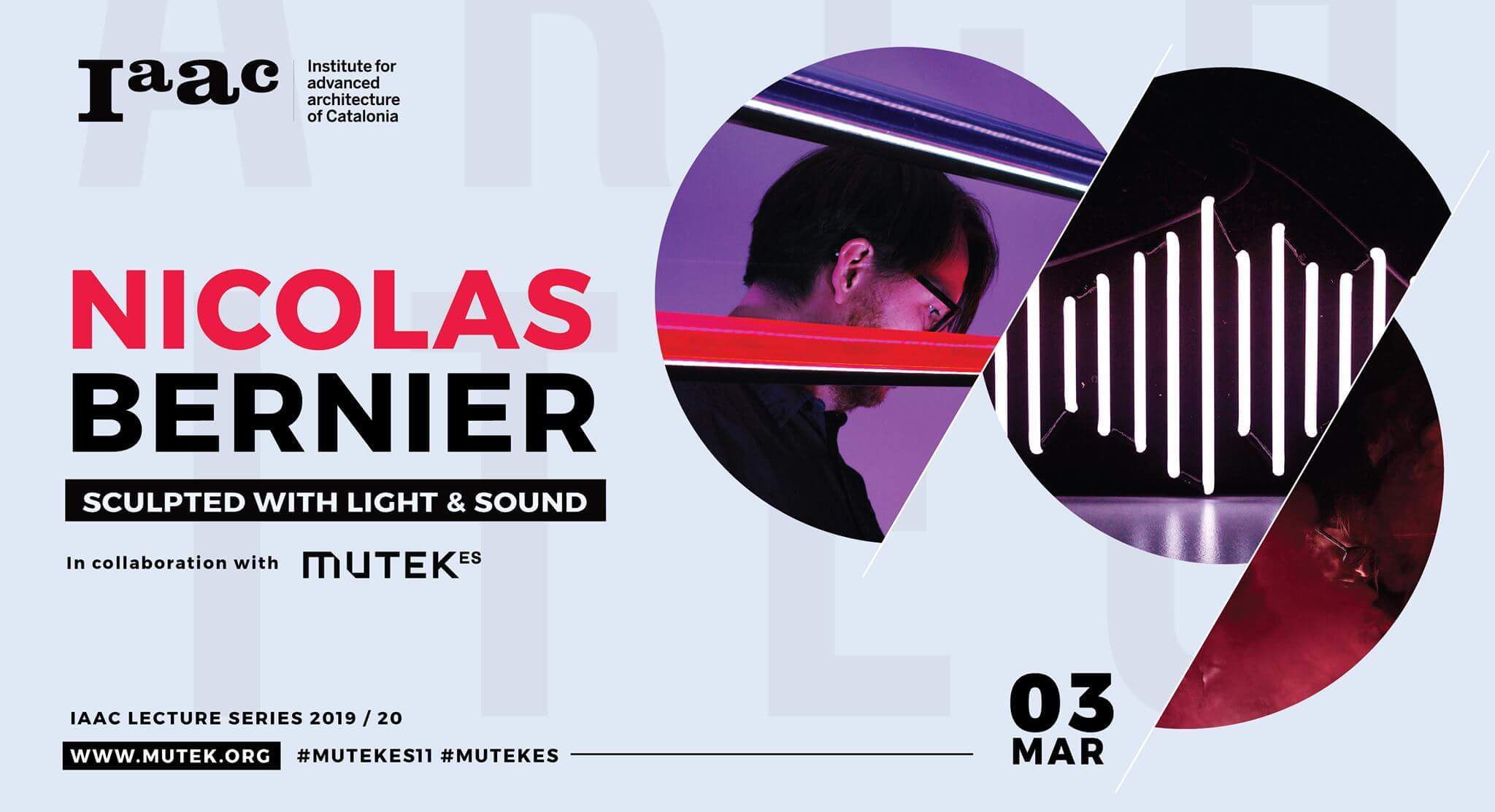
Nicolas Bernier Lecture

“Sculpted with Light and Sound” Lecture by Nicolas Bernier at IAAC

Nicolas Bernier creates audiovisual performances and installations aiming to carve a dialogue between sound and tangible matter. Shaped by his work within the fields of cinema, literature, dance and theatre companies, his own language blend together elements of music, photography, design, science, video art, architecture, light design and scenography. In the midst of this eclecticism, his artistic concerns remain constant: the balance between the cerebral and the sensual, and between organic sources and digital processing.

blank

Awardee of the prestigious Golden Nica at Prix Ars Electronica 2013 (Austria), his work widely recognize, presented all over the world: SONAR (Spain), Mutek (Canada), Elektra (Canada), ZKM (Germany), Transmediale (Germany) and LABoral (Spain) to name a few. His sound compositions are widely published on electronic music labels: 901 Editions (Italy), LINE (US), leerraum (Switzerland), Entr’acte (UK) and empreintes DIGITALes (Québec).

He holds a PhD in sonic arts from the University of Huddersfield (UK). He is a member of Perte de signal, CIRMMT and Hexagram media arts research and development centres based in Montreal. He is teaching in the Digital Music program of the Université de Montréal.

IAAC Lecture Series 2019/20

3rd of March 2020 @ 19.30, IAAC Auditorium
Nicolas Bernier In collaboration with MUTEK

Sculpted with Light and Sound

Free and Open to the Public

×