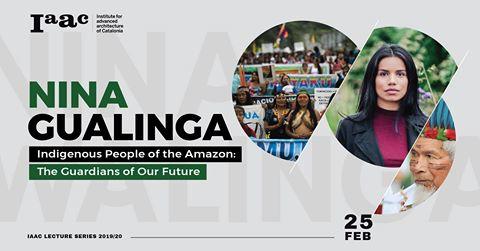
Nina Gualinga Lecture

Indigenous People of the Amazon: The Guardians of Our Future Lecture by Nina Gualinga at IAAC

Nina Gualinga is of Swedish and indigenous roots of the Ecuadorian Amazon, where she was born and raised in her mother’s community of the Kichwa People of Sarayaku.  Nina started advocating for  indigenous and territorial rights at the at a early age, after an oil companies violently entered her peoples’ lands with military troops provided by the Ecuadorian government. The people of Sarayaku successfully forced out the oil company and militars and won a historic case against the government  in the Interamerican Court of Human Rights, setting an important precedent for indigenous rights across Latin America.

blank

Throughout her life Nina has been actively involved in national and global advocacy efforts in defense of the Amazon rainforest, indigenous rights and the world climate. She is a spokesperson for the Mujeres Amazonicas, a movement that unites indigenous women in the Ecuadorian Amazon. She is also board member of Amazon Watch in Sweden, where she studies Human Rights at the University of Lund.

Nina uses her story and voice to raise awareness of the challenges that Indigenous People face across the world in their struggles to protect their home against extractive industries and for all life on Earth.

IAAC Lecture Series 2019/20

25th of February 2020
Nina Gualinga
Activist for indigenous and territorial rights

Indigenous People of the Amazon: The Guardians of Our Future

@ 19.30, IAAC Auditorium
Free and Open to the Public

More

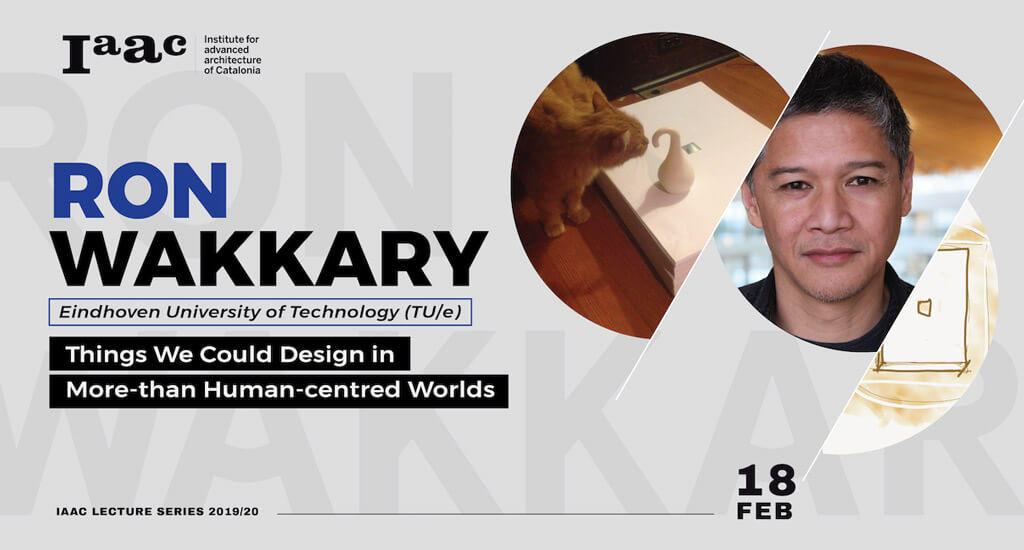
Ron Wakkary Lecture

Ron Wakkary is full professor in the School of Interactive Arts and Technology, Simon Fraser University in Canada where he is the founder of the Everyday Design Studio (eds.siat.sfu.ca). In addition, he is full professor in Industrial Design, Eindhoven University of Technology in the Future Everyday cluster.

blank

Wakkary is interested in design-oriented human-computer interaction (HCI) and the philosophies of technologies through design. Wakkary’s research investigates the changing nature of interaction design and HCI in response to new understandings of human-technology relations.

Ron is currently a member of the Tangible Embedded/Embodied Interaction (TEI) and Designing Interactive Systems (DIS) steering committees. He is also a member of various editorial boards including International Journal of Design (IJD). He was co-Editor-in-Chief of ACM interactions from 2010 to 2016.

IAAC Lecture Series 2019/20

18th of February 2020
Ron Wakkary
Simon Fraser University / TU Eindhoven

Things We Could Design in More-than Human-centred Worlds

@ 19.30, IAAC Auditorium
Free and Open to the Public

Since 2000, IAAC runs an international IAAC Lecture Series in which architects and experts from a variety of different disciplines present their work at IAAC. The lectures are open to the public, consisting of a high-quality cultural activity open to the city of Barcelona. Unless otherwise indicated, all the events of the Series are free with a mandatory Eventbrite registration.

More

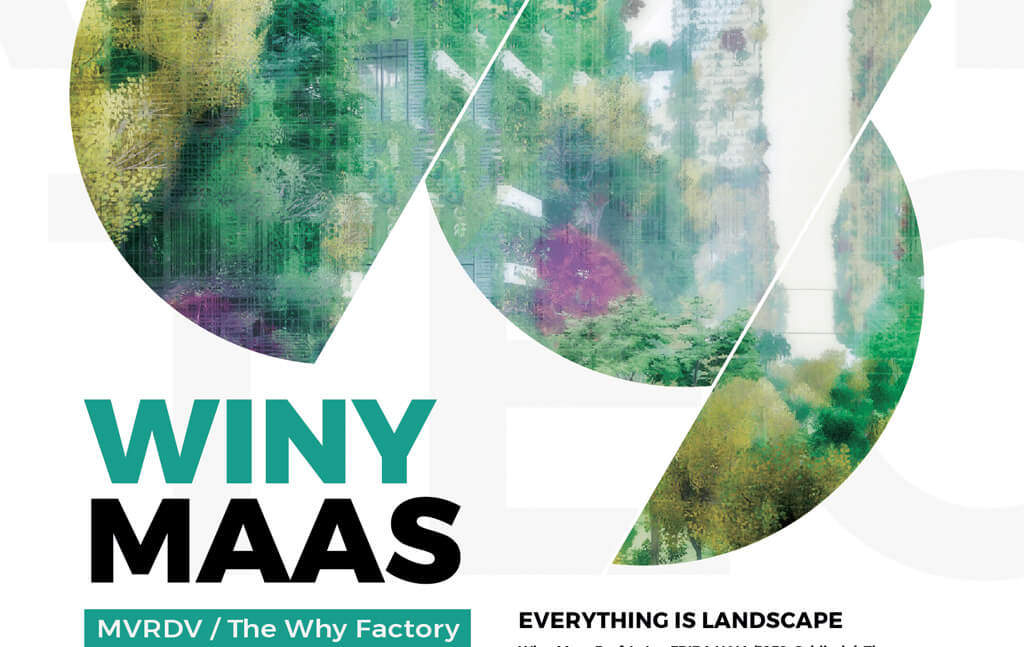
Winy Maas Lecture

Everything is Landscape Lecture by Winy Maas at IAAC Lecture Series 2020

Winy Maas and one of the co-founding directors of the globally operating architecture and urban planning firm MVRDV, based in Rotterdam, Netherlands, known for projects such as the Expo 2000, the vision for greater Paris, Grand Paris Plus Petit, and more recently the Market Hall in Rotterdam. He is furthermore professor at and director of The Why Factory, a research institute for the future city, he founded in 2008 at TU Delft.


blank

He is currently Visiting Professor at IIT Chicago, the Catholic University of Louvain, Belgium and the University of Hong Kong, and has been at ETH Zurich, Berlage Institute, MIT, Ohio State and Yale University. In addition, he designs stage sets, objects and was a curator of Indesem 2007. He curates exhibitions, lectures throughout the world and takes part in international juries.

In 2013 Winy Maas joined the Economic Development Board of Rotterdam (EDBR). In 2012 he was appointed urban supervisor for the city of Almere and since 2003 he has been supervising the Bjørvika urban development in Oslo. With both MVRDV and The Why Factory he has published a series of research projects.

IAAC Lecture Series 2019/20

10th of February 2020
Winy Maas
MVRDV / The Why Factory / IAAC Faculty

Everything is Landscape

@ 19.30, IAAC Auditorium
Free and Open to the Public

More

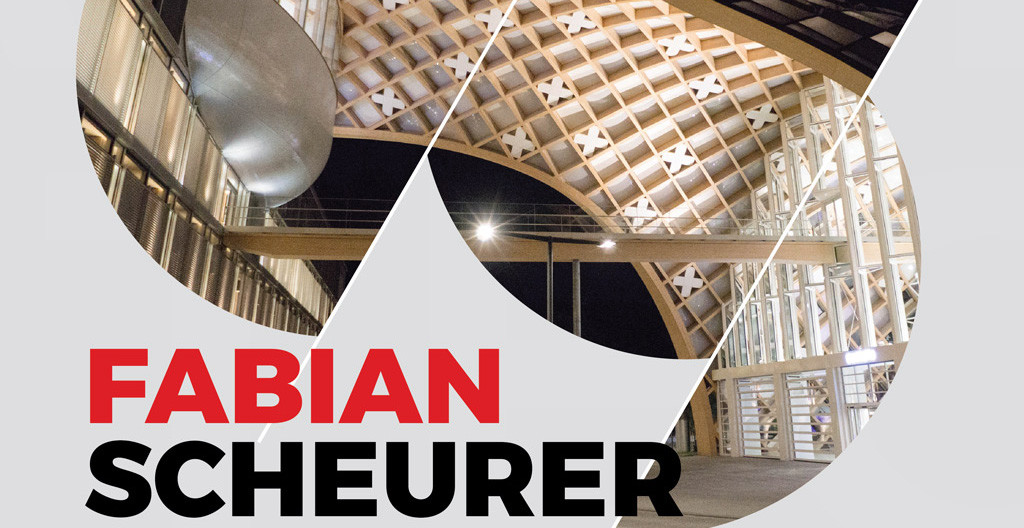
Fabian Scheurer Lecture

 IAAC Lecture Series: Fabian Scheurer

Fabian Scheurer is co-founder of Design-to-Production and leads the company’s office in Zurich. After graduating from the Technical University of Munich with a diploma in computer science and architecture, he worked as assistant for the university’s CAAD group, as software developer for CAD-provider Nemetschek, and as new media consultant for Eclat in Zurich.

blank

From 2002 until 2006 he studied the use of artificial-life methods in architectural construction as a member of Ludger Hovestadt’s CAAD group at the ETH Zurich and managed to transfer the results to a number of collaborative projects between architects, engineers, and fabrication experts. In 2005 he co-founded Design-to-Production as a research group at ETH to explore the connections between digital design and fabrication.

At the end of 2006 Design-to-Production teamed up with architect Arnold Walz and became a commercial consulting practice, since then having implemented digital planning and production chains for projects like the Hungerburg-Funicular in Innsbruck (by Zaha Hadid), the Rolex Learning Center in Lausanne (by SANAA), the Centre Pompidou in Metz, La Seine Musicale in Paris, Swatch in Biel (all three by Shigeru Ban) and many others.

Fabian Scheurer has been teaching Digital Modeling and Fabrication as guest lecturer/tutor at the AA in London, the IAAC in Barcelona, and at HTW Chur and BFH Biel (Switzerland).


IAAC Lecture Series 2019/20

4th of February 2020
Fabian Scheurer
Design-to-production / IAAC Faculty

BIM to Fabrication

@ 19.30, IAAC Auditorium
Free and Open to the Public

More

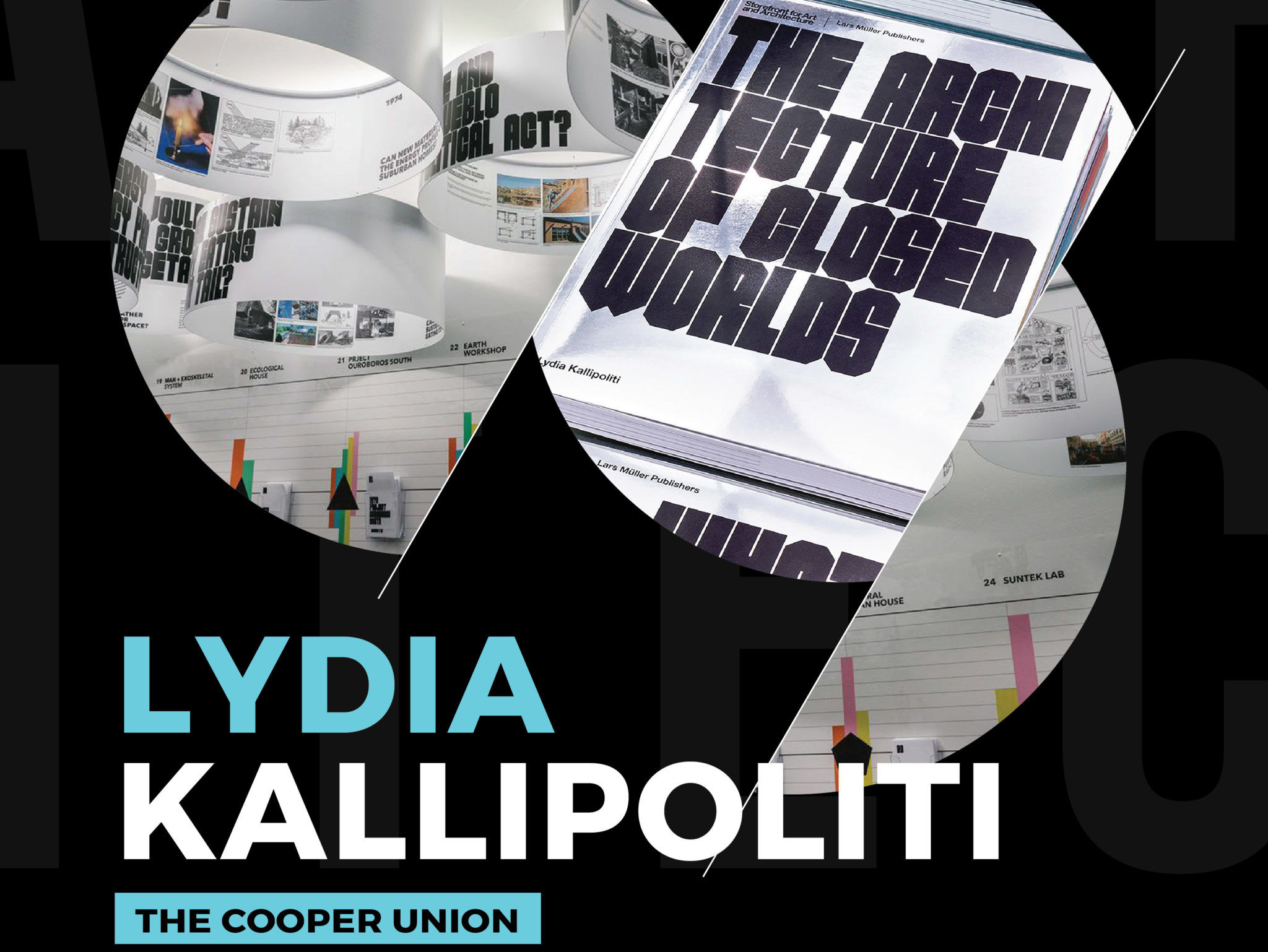
Lydia Kallipoliti Lecture

The Cooper Union, Lydia Kallipoliti lECTURE at IAAC Lecture Series 2020

Lydia Kallipoliti is an architect, engineer and scholar. She holds a Diploma in Architecture and Engineering from the Aristotle University of Thessaloniki (Greece), a SMArchS in design and building technology from M.I.T, as well as a Master of Arts and a PhD from Princeton University.

blank

Prior to Cooper Union, Kallipoliti was an Assistant Professor at Rensselaer Polytechnic Institute where she directed the MSArch Program, an Assistant Professor at Syracuse University and an Assistant Professor Adjunct at Columbia University [GSAPP] and at the Cooper Union, where she served as a Senior Associate at the Institute for Sustainable Design, and as the Feltman Chair in Lighting.

Her research focuses on the intersections of architecture, technology and environmental politics and more particularly on recycling material experiments, theories of waste and reuse, as well as closed and self-reliant systems and urban environments.

IAAC Lecture Series 2019/20

10th of January 2020
Lydia Kallipoliti
The Cooper Union

The Architecture of Closed Worlds

@ 19.30, IAAC Auditorium
Free and Open to the Public

More

Lacol + Harquitectes Lecture

Lacol arquitectura cooperativa + Harquitectes at IAAC Lecture Series 2019/20

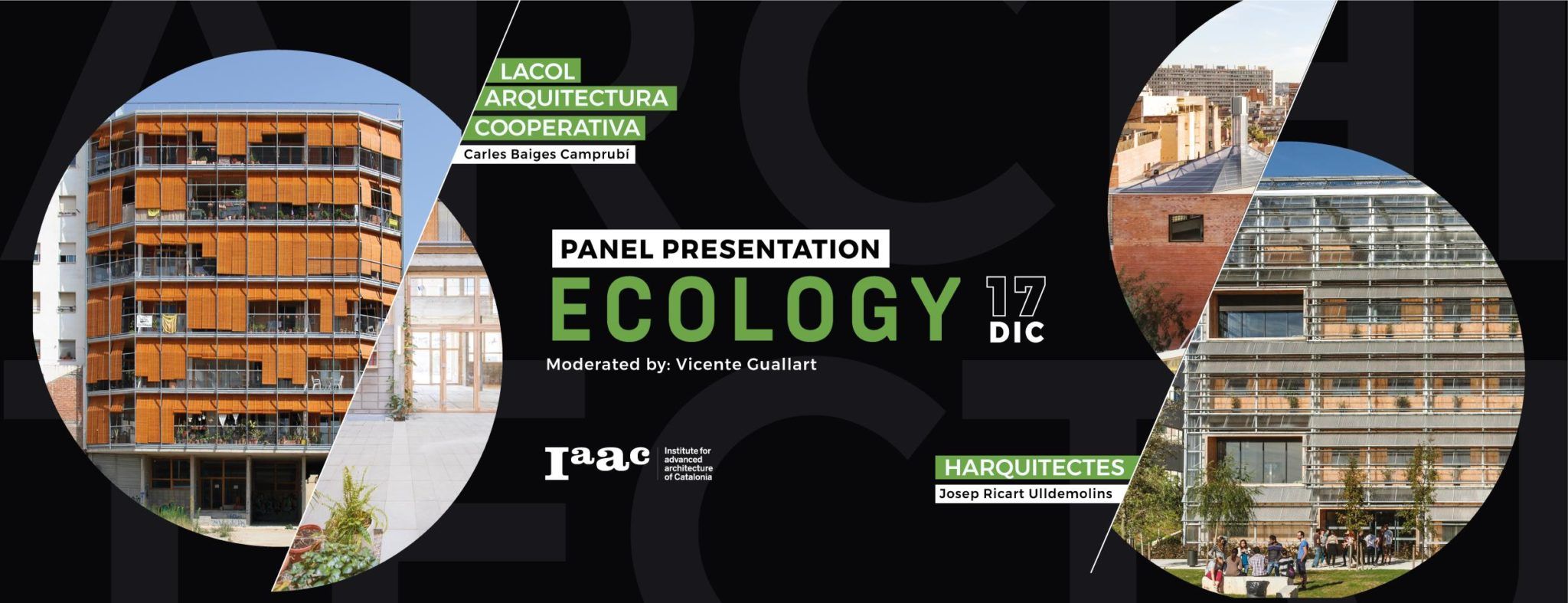
This year, three special events will aim to give an overview on the Catalan architectural scene, by presenting six local firms with a special focus on three themes: Regeneration, Urbanism and Ecology. Tomorrow 17th December Lacol and Harquitectes with the lecture “Panel Presentation” under de theme Ecology.

blank

LACOL is a cooperative of architects who work in the neighbourhood of Sants, in Barcelona. They work from architecture toward social transformation, using architecture as a tool to intervene critically in their close environment. They root their activity in a horizontal system of labor, acting alongside society with justice and solidarity in mind. Carles Baiges Camprubí, is an architect (UPC-ETSAB) and master in Urban Sociology (Universiteit van Amsterdam). He is a founding member of the architects cooperative LACOL, where he focuses on cooperative housing and citizen participation and collaborates in projects and research in La Dinamo, a foundation to support cooperative housing.

HARQUITECTES is an architecture studio established in 2000 and based in Barcelona. It is managed by four partner architects: David Lorente Ibáñez, Josep Ricart Ulldemolins, Xavier Ros Majó and Roger Tudó Galí, who count on an ample team of collaborators, such as architects, interior designers and students. All of them licensed between 1998 and 2000 in ETSAV (UPC), where Josep and Roger teach in the Department of Architectural Projects and Technology. Xavier also teaches Projects in the ETSA Barcelona. Their work has received many awards and it has been published in many national and international media. They have also been selected in various exhibitions and invited as teachers and lecturers in Europe and America.


IAAC Lecture Series 2019/20

17th of December 2019
Lacol + Harquitectes
Panel Presentation

Ecology

@ 19.30, IAAC Auditorium
Free and Open to the Public

More

Responsive Cities 2019

15-16 November 2019 Responsive cities Symposium

Responsive Cities is a bi-annual international symposium on the future of cities organized by the Advanced Architecture Group of IAAC. The 2019 edition focuses on “Disrupting through Circular Design” within the framework of the Creative Food Cycles (CFC) project, co-funded by the Creative Europe Programme of the European Union and developed by the Institute for Advanced Architecture of Catalonia, the Leibniz University of Hannover and the University of Genoa.

blank
It is clear that what comes next for our buildings and cities is a future full of challenges. With more than half of the world’s population currently living in cities, and 70% expected to by 2050, urban areas face huge pressure to meet their residents’ needs. Increased urbanisation is pushing for cities to respond through more accessible housing, energy, food and water, as well as more efficient transportation systems. This is resulting in an undeniable rise of resource consumption, and ultimately resulting in growing amounts of greenhouse gas emissions and waste. Moreover, with buildings being responsible for 40% of energy consumption, 36% of CO2 emissions, and the building industry being one of the heaviest waste generators globally, it is indispensable for architecture to respond, pushing for alternative design and construction models, moving away from the current prevailing models-both intensely resources-consuming and contaminating.

The notions of materialising, managing, and constructing are changing: the Responsive Cities symposium’s objective is to investigate how innovative and advanced technologies in the field of design (i.e. biotechnology, big data analysis, predictive modelling, engineered materials, digital manufacturing, etc.) can help to enhance and strengthen the implementation of circular processes in the urban environment.

· How can circular design disrupt linear patterns of extractive consumption, towards design scenarios where the urban environment becomes productive and healing in itself?

· Which digital technologies have the power to enhance the performance of and with our urban built environment?

· How can architectural design secure circularity in cities and contribute to the UN SDG goals of sustainable consumption and production patterns?

The main focus of the Symposium is placed on key concepts such as designing for flexible uses and systems integration; performing through circular feedback systems; adapting with nature-based solutions; building for resource recovery, or learning through advancements related to technological innovation. As protagonists in the creation of urban, built and public space, we can guide decisions towards more circular choices, and build local partnerships with businesses, across disciplines, moving towards a responsive circular city.

The Responsive Cities Symposium_Disrupting through Circular Design is organized around the following topics:

DESIGN – multi-programming | hybrid simulations | predictive modelling | non-linear systems
BUILD – circular construction | on-site manufacturing | resource recovery
ADAPT – nature-based solutions | advanced and bio materials | synthetic ecologies
PERFORM – self-organization | circular feedback systems | autonomous behavior
SHARE – participatory design  | blockchain | sharing economies
LEARN – new educational models | applied research | making | raise awareness

Program

More
Carlo Ratti Lecture

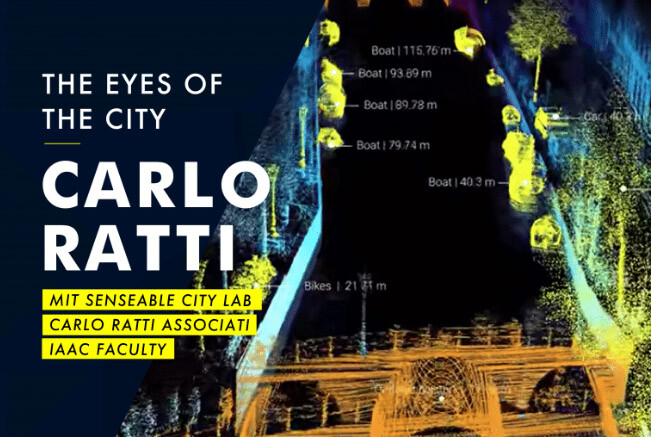
Carlo Ratti Lecture “The Eyes of the City” at IAAC Lecture Series 2019

An architect and engineer by training, Carlo Ratti practices in Italy and teaches at the Massachusetts Institute of Technology, where he directs the Senseable City Lab. He graduated from the Politecnico di Torino and the École Nationale des Ponts et Chaussées in Paris, and later earned his MPhil and PhD at the University of Cambridge, UK.

blank

Carlo holds several patents and has co-authored over 250 publications. As well as being a regular contributor to the architecture magazine Domus and the Italian newspaper Il Sole 24 Ore, he has written for the BBC, La Stampa, Scientific American and The New York Times. His work has been exhibited worldwide at venues such as the Venice Biennale, the Design Museum Barcelona, the Science Museum in London, GAFTA in San Francisco, MoMA in New York and MAXXI in Rome.

Carlo has been featured in Esquire Magazine’s ‘2008 Best & Brightest’ list and in Thames & Hudson’s selection of ‘60 innovators’ shaping our creative future. In 2010 Blueprint Magazine included him as one of the ‘25 People Who Will Change the World of Design’, Forbes listed him as one of the ‘Names You Need To Know’ in 2011 and Fast Company named him as one of the ’50 Most Influential Designers in America’.


IAAC Lecture Series 2018/19

22nd of May 2019
Carlo Ratti
MIT Senseable City Lab / Carlo Ratti Associati / IAAC

The Eyes of the City

@ 19.30, IAAC Auditorium
Free and Open to the Public

Benedetta Tagliabue at IAAC Lecture Series

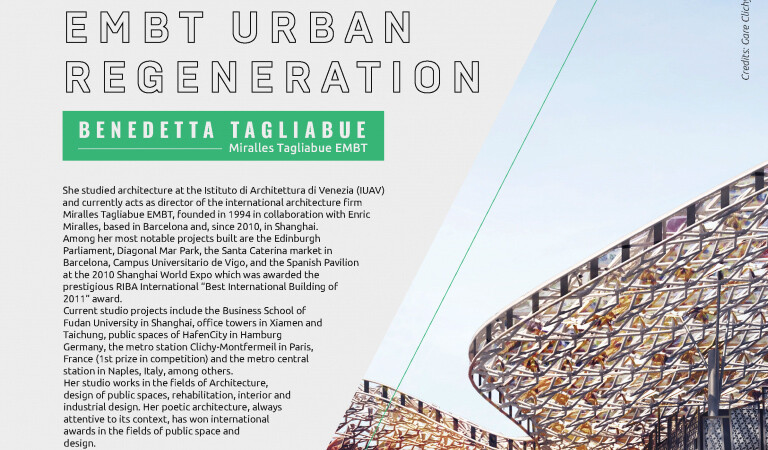
Benedetta Tagliabue Lecture: Better City, Better Life – EMBT Urban Regeneration

Benedetta Tagliabue studied architecture at the Istituto di Architettura di Venezia (IUAV) and currently acts as director of the international architecture firm Miralles Tagliabue EMBT, founded in 1994 in collaboration with Enric Miralles, based in Barcelona and, since 2010, in Shanghai. Among her most notable projects built are the Edinburgh Parliament, Diagonal Mar Park, the Santa Caterina market in Barcelona, Campus Universitario de Vigo, and the Spanish Pavilion at the 2010 Shanghai World Expo which was awarded the prestigious RIBA International “Best International Building of 2011” award.

blank

Current studio projects include the Business School of Fudan University in Shanghai, office towers in Xiamen and Taichung, public spaces of HafenCity in Hamburg Germany, the metro station Clichy-Montfermeil in Paris, France and the metro central station in Naples, Italy, among others. Her studio works in the fields of Architecture, design of public spaces, rehabilitation, interior and industrial design. Her poetic architecture, always attentive to its context, has won international awards in the fields of public space and design.

IAAC Lecture Series 2018/19 4h of December 2018
In Collaboration with the Enric Miralles Foundation

Benedetta Tagliabue- Miralles Tagliabue EMBT

Better City, Better Life – EMBT Urban Regeneration

@ 19.30, IAAC Auditorium
Free and Open to the Public

Shajay Bhooshan at IAAC Lecture Series

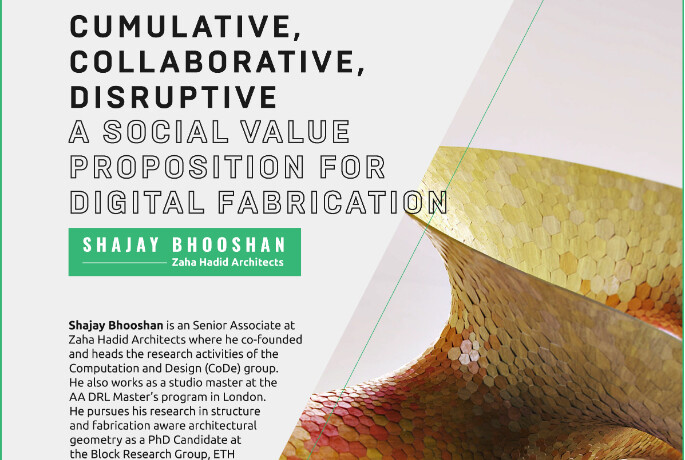
Shajay Bhooshan Lecture: Cumulative, Collaborative, Disruptive – A Social Value Proposition for Digital Fabrication

Shajay Bhooshan is an Senior Associate at Zaha Hadid Architects where he co-founded and heads the research activities of the Computation and Design (CoDe) group. He also works as a studio master at the AA DRL Master’s program in London. He pursues his research in structure and fabrication aware architectural geometry as a PhD Candidate at the Block Research Group, ETH Zurich.

blank

Previously, he has worked at Populous, London and completed his M.Phil from the university of Bath and M. Arch from the AA School of Architecture, London. His current interests & responsibilities include developing design-research and maintaining computational platforms for the same at Zaha Hadid Architects. He has taught and presented work at various professional conferences, events and institutions across the world including Architectural Association London, ETH Zurich, Poly-technic of Milan, Tongji University Shanghai, SIGGRAPH, Autodesk university etc.

IAAC Lecture Series 2018/19
Master in Robotics and Advanced Construction

27th of November 2018
Shajay Bhooshan
Zaha Hadid Architects / IAAC Faculty

Cumulative, Collaborative, Disruptive – A Social Value Proposition for Digital Fabrication

@ 19.30, IAAC Auditorium
Free and Open to the Public

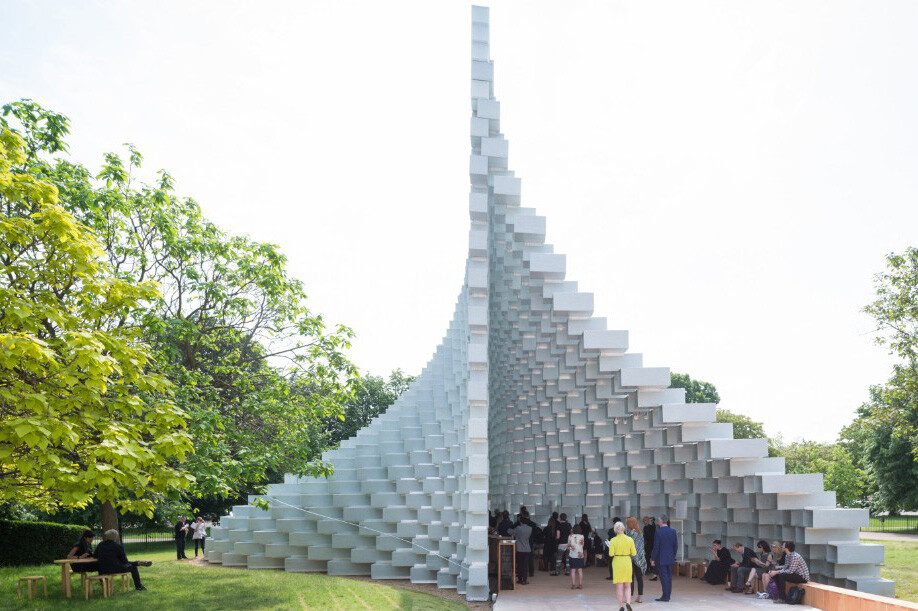
Bjarke Ingels Lecture at IAAC

IAAC Closing Lecture 2018 // Bjarke Ingels – BIG

Bjarke Ingels, Founding Partner and Creative Director of BIG, the most widely envied professional practice of the moment, with its head office in Copenhagen and branches in London and New York City, will be giving the Closing Lecture of the 2017/18 IAAC Lecture Series next 15th of June at IAAC.

blank

The firm BIG is currently developing projects such as the Google Building, Mountain View (USA), the Amager Resource Center in Copenhagen, or the 2WTC Skyscraper in the New York Zero Zone.

blank

Fri, June 15, 2018  7:00 PM – 10:00 PM

Institute for Advanced Architecture of Catalonia

102 Carrer de Pujades  08005 Barcelona

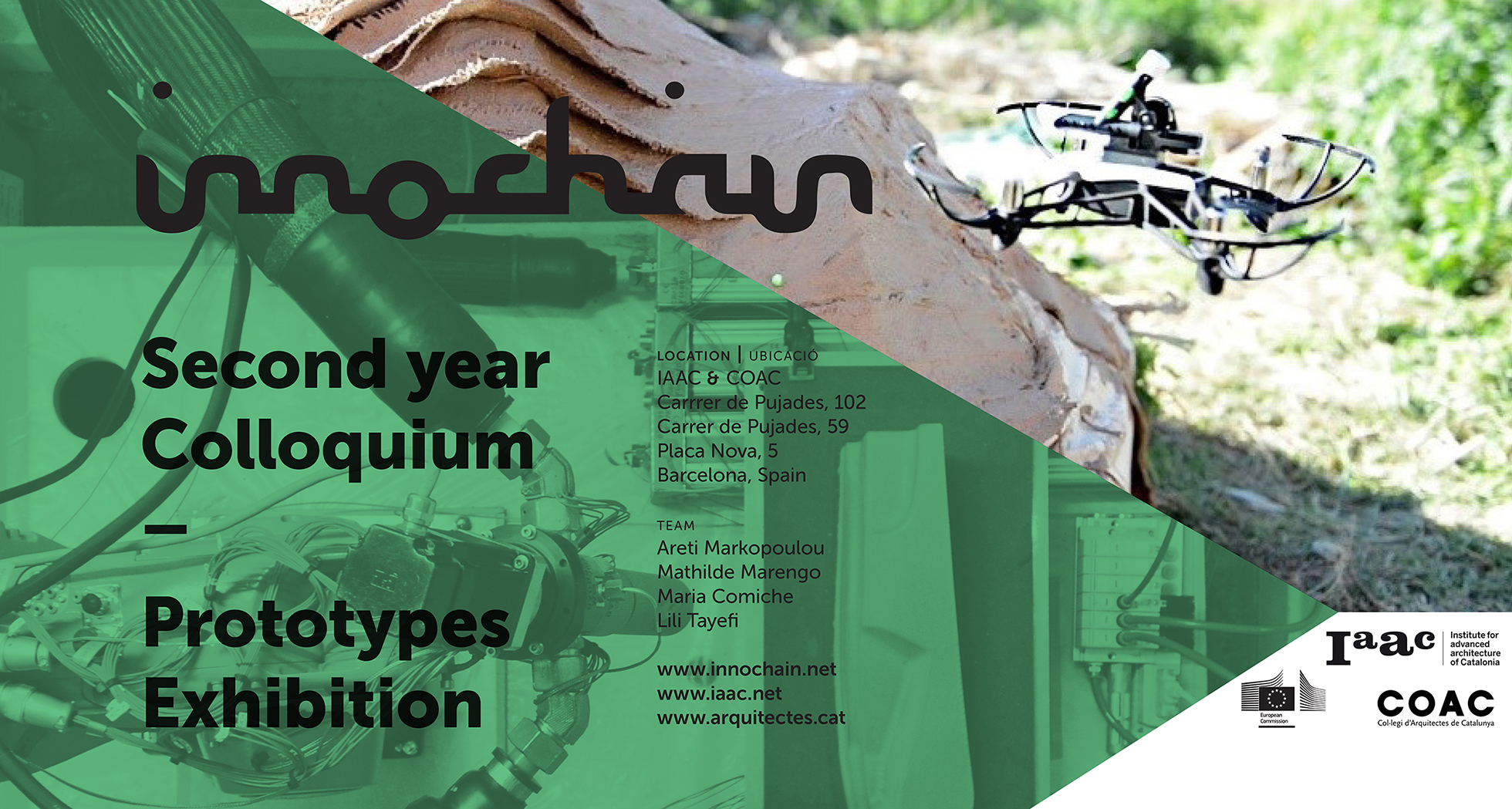
InnoChain Colloquium: Prototypes

SECOND YEAR INNOCHAIN COLLOQUIUM AND RESEARCH EXHIBITION “PROTOTYPES” IN BARCELONA

The InnoChain Second Year Colloquium, which will take place between the 12th and the 14th of February 2018, is an evaluation event in which all Early Stage Researcher (ESRs) present their research development.

The InnoChain ITN Network is a shared research training environment examining how advances in digital design tools challenge building culture enabling sustainable, informed and materially smart design solutions. The network aims to train a new generation of interdisciplinary researchers, through the development of 15 PhDs, with a strong industry focus that can effect real changes in the way we think, design and build our physical environment.

blank

The Second Year Colloquium invites therefore all beneficiaries and industry partners to discuss the research development of the ESR projects in plenum. This includes review and evaluation of industrial collaboration and secondment programme including the secondment periods.

Keynote speakers will give lectures to support the further research development and invited scientists will carry out evaluation of level of work and progress within the network. In addition, meetings of the Industry Partner Board takes place on the second day, while meetings of the Steering Committee and ESRs’ will take place on the third day of the Colloquium.

The Colloquium is organised around three sessions presenting the three Work Packages:

WP3 Communicating Design, Chair Jan Knippers, ITKE
WP4 Simulating for Design, Chair Ulrika Knagenhielm-Karlsson, KTH
WP5 Materialising Design, Chair Bob Sheil, BSA

Visiting Scientists: Mark Burry and Jane Burry (Swinburne University); Christoph Gengnagel (Berlin University of the Arts).
PROTOTYPES – Research Exhibition

The Second InnoChain Exhibition “Prototypes” focuses on the role of the industry collaboration as a driving force for the development of the InnoChain project. For this ESRs are asked to showcase their industry collaborations, which they have been working on through their secondments over the recent past.

The ESRs will use videos to show how their industry partner collaboration is going; a dialogue on what is the interest for both sides to accelerate the research being developed. This video content will be illustrated with a series of prototypes of the latest work being developed by the ESRs.

More

IAAC Responsive Cities Symposium 2017

Responsive Cities Symposium 2017_Active Public Space // Barcelona – 13th and 14th of November.

IAAC > Institute forAdvanced Architecture of Catalonia is pleased to invite you to Responsive Cities Symposium 2017, the second edition of the international gathering about the future of our cities, that will take place in Barcelona on the 13th and 14th of November 2017, in collaboration with the Creative Europe Programme of the European Union and supported by the Caixa Forum and Smart City Expo World Congress.

blank

Speakers: Helle Søholt, Gala Pin, Nataly Gattegno, Usman Haque, Claudia Pasquero, Luis Falcon, Pontus Westerberg and Areti Markopoulou, will be some of the personalities who will discuss several topics on Active Public Space project.

The purpose of the symposium is to investigate possible applications of new technologies in dynamic public spaces. The focus will be on the advancements of information technologies, interaction and fabrication of public space as catalyst to achieve high quality of life.

Responsive Cities Symposium 2017 is organized as part of the APS (Active Public Space) project, co-financed by the European Creative Europe Programme and developed by the Institute for Advanced Architecture of Catalonia, the Center for Central European Architecture and the University of Applied Arts Vienna.

Last year, during the RC Symposium 2016  and on the topic of Urbanism in the Experience Age, we had the pleasure to receive more than 500 participants from all over the world including Speakers such as Saskia Sassen, Janet Sanz, Martina Hallikainen, Maita Fernandez and more.

The event is free and open to public. To attend, please register your seat here

Discover more about Responsive Cities Symposium 2017 here

Title: Responsive Cities Symposium 2017 // Active Public Space

Type: Symposium

Website: http://responsivecities2017.iaac.net/

Dates and Venues:

13th November – Caixa Forum

14th November – Smart City Expo World Congress

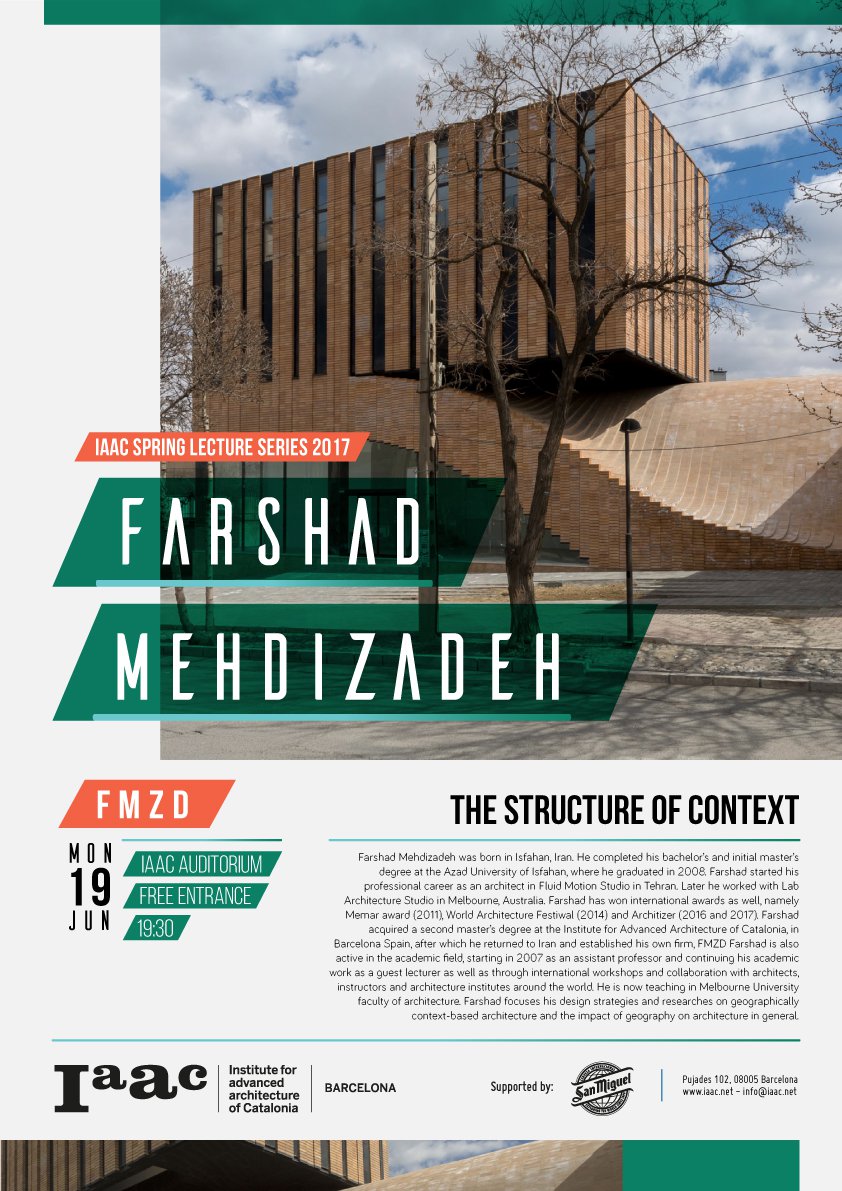
Farshad Mehdizadeh IAAC Lecture Series

Farshad Mehdizadeh Lecture: The Structure of Context.

Farshad Mehdizadeh was born in Isfahan, Iran. He completed his bachelor’s and initial master’s degree at the Azad University of Isfahan, where he graduated in 2008. Farshad started his professional career as an architect in Fluid Motion Studio in Tehran. Later he worked with Lab Architecture Studio in Melbourne, Australia. Farshad has won international awards as well, namely Memar award (2011), World Architecture Festiwal (2014) and Architizer (2016 and 2017).

Farshad acquired a second master’s degree at the Institute for Advanced Architecture of Catalonia, in Barcelona Spain, after which he returned to Iran and established his own firm, FMZD Farshad is also active in the academic field, starting in 2007 as an assistant professor and continuing his academic work as a guest lecturer as well as through international workshops and collaboration with architects, instructors and architecture institutes around the world. He is now teaching in Melbourne University faculty of architecture. Farshad focuses his design strategies and researches on geographically context-based architecture and the impact of geography on architecture in general.

blank

IAAC Lecture Series 2016/17

Monday 19th of June 2017
Farshad Mehdizadeh
FMZD

The Structure of Context

@ 19.30, IAAC Auditorium
Open to the Public

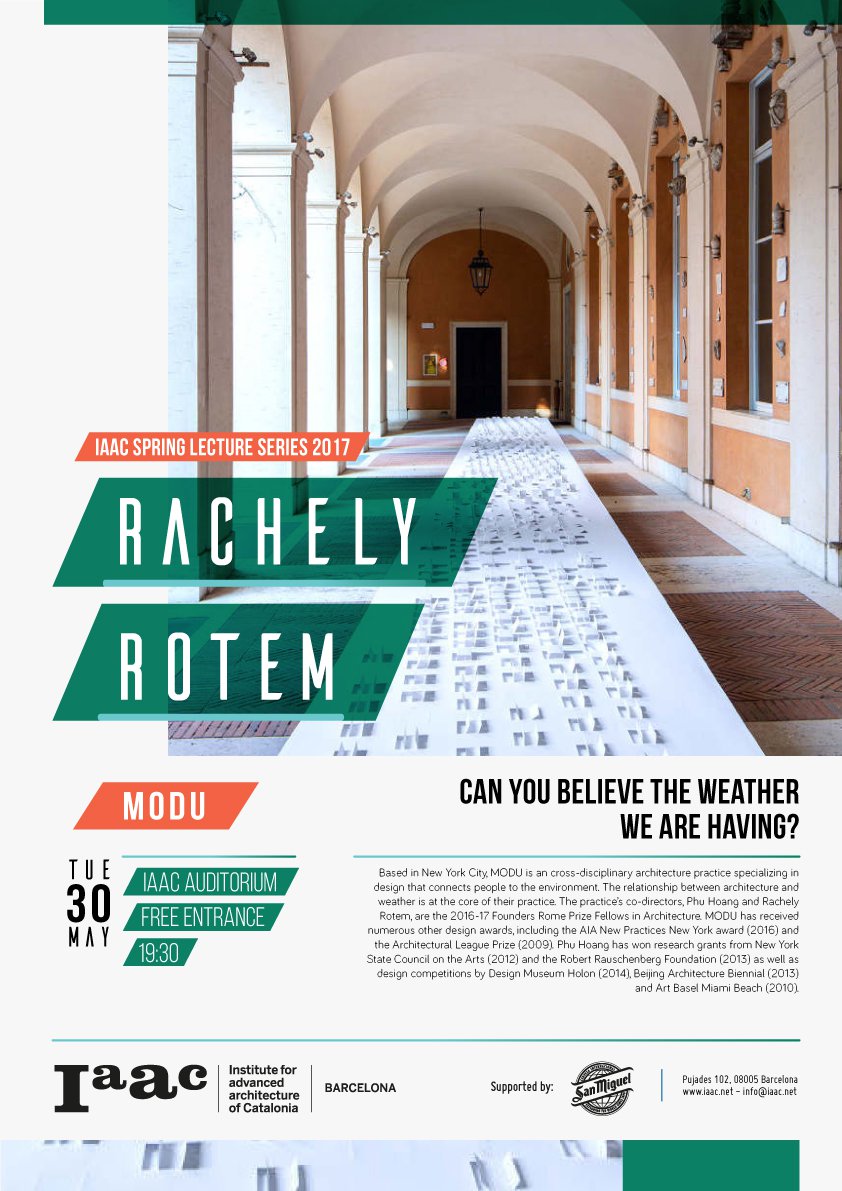
Rachely Rotem IAAC Lecture Series

Rachely Rotem Lecture: Can you believe the weather we are having?

Based in New York City, MODU is an cross-disciplinary architecture practice specializing in design that connects people to the environment. The relationship between architecture and weather is at the core of their practice. The practice’s co-directors, Phu Hoang and Rachely Rotem, are the 2016-17 Founders Rome Prize Fellows in Architecture.

MODU has received numerous other design awards, including the AIA New Practices New York award (2016) and the Architectural League Prize (2009). Phu Hoang has won research grants from New York State Council on the Arts (2012) and the Robert Rauschenberg Foundation (2013) as well as design competitions by Design Museum Holon (2014), Beijing Architecture Biennial (2013) and Art Basel Miami Beach (2010).


blank

IAAC Lecture Series 2016/17

Tuesday 30th of May 2017
Rachely Rotem
MODU

Can you believe the weather we are having?

@ 19.30, IAAC Auditorium
Open to the Public

×