Jose Sanchez Lecture

IAAC Lecture Series 2017 Jose Sanchez

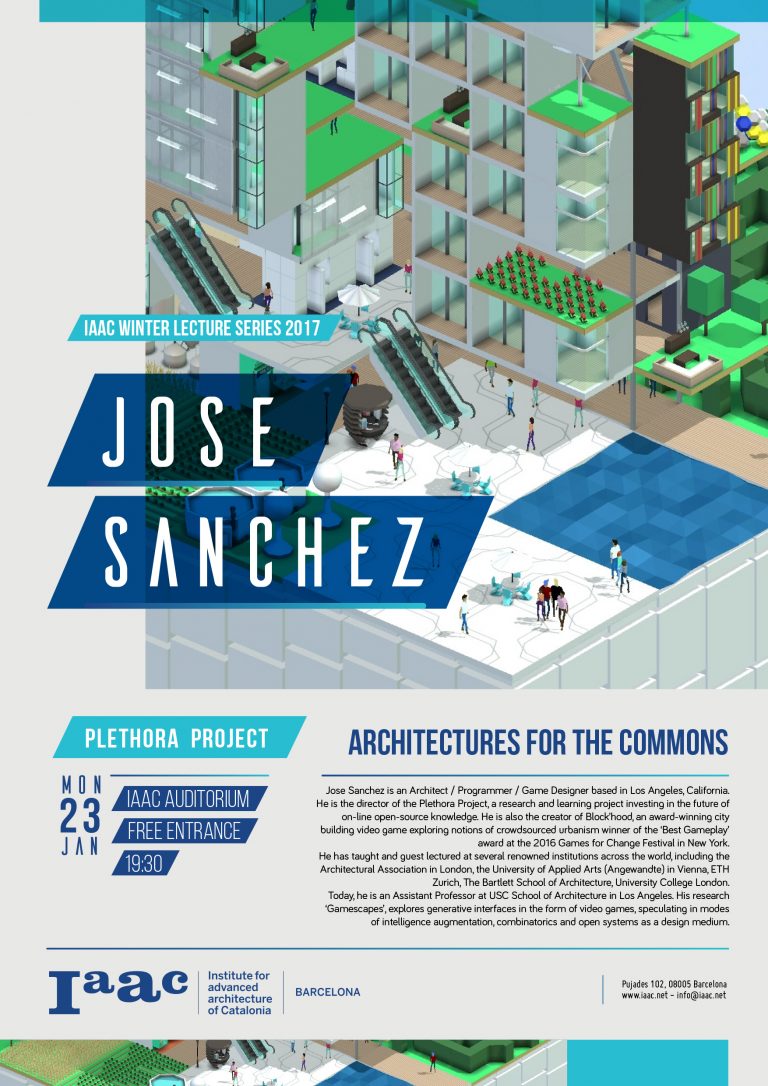
Jose Sanchez is an Architect / Programmer / Game Designer based in Los Angeles, California. He is the director of the Plethora Project, a research and learning project investing in the future of on-line open-source knowledge. He is also the creator of Block’hood, an award-winning city building video ame exploring notions of crowdsourced urbanism winner of the ‘Best Gameplay’ award at the 2016 Games for Change Festival in New York.

He has taught and guest lectured at several renowned institutions across the world, including the Architectural Association in London, the University of Applied Arts (Angewandte) in Vienna, ETH Zurich, The Bartlett School of Architecture, University College London. Today, he is an Assistant Professor at USC School of Architecture in Los Angeles. His research ‘Gamescapes’, explores generative interfaces in the form of video games, speculating in modes of intelligence augmentation, combinatorics and open systems as a design medium.

IAAC Lecture Series 2016/17

Monday 23rd of January 2017
Jose Sanchez
plethora-project

Architectures for the Commons

@ 19.30, IAAC Auditorium
Open to the Public

Do you live in Barcelona? Come and walk with us!

Barcelona Walks

Today we want to invite all those who live in Barcelona to take a walk with us.

Often, the history, the culture and the politics as well as the architecture of the city in which we live hide secrets, which go unnoticed by most of us in our daily lives. That’s why our Barcelona Architecture Walks are a great opportunity to discover and enjoy the city from another point of view.

Barcelona is an amazing city full of incredible stories that you can discover with us.

Precisely, about that is the testimony of one of our last walkers…

“A different way to see the city”

We thoroughly enjoyed our “Barcelona and the Sea” walking tour. We have lived in the city for 5 years, but didn’t realise how little we know about its architectural history until we did this tour. We would strongly recommend it to anyone who has a passion for Barcelona or for architecture.

More reviews


blank

Walk with us and immerse yourself in a city that will not leave you indifferent.

We remind you that we continue with our walking tours as usual:

BARCELONA & GAUDI a great start to discover the genius of Gaudí.

& THE SEA  discover Barcelona through its architecture.

& THE FUTURE CITY walk through the smart city looking for our Future and discover with us the new Superblock at Poblenou.

& THE URBANISM travel with us to the origins of the modern Barcelona.

& THE MARKET see Barcelona through the eyes of Enric Miralles.

COME ON GUYS LET’S WALK WITH US AND LIVE AN AMAZING EXPERIENCE!


Arranca la 7ª edición del ciclo de cine Ecumenópolis

Ecumenópolis adopta un nuevo formato

Este año la programación del Ecumenópolis adopta un nuevo formato. Ampliamos el campo de visión con sesiones más variadas y diferentes puntos de vista. Cada una de las sesiones estará comisariada por un invitado o invitada.

Los invitados serán arquitectos con una relación directa con el mundo audiovisual y la imagen en movimiento. De la performance multimedia a la producción de piezas inéditas, pasando por la presentación de proyectos de ciudad o formativos, las sesiones serán variadas y singulares, convirtiendo el Ecumenópolis en un verdadero espacio de reflexión audiovisual alrededor del urbanismo y la arquitectura.

blank

© Col·legi d’Arquitectes de Catalunya (COAC)


Programación:

Viernes 20 de enero
Debate Videológico: presentación de la programación con la presencia de Andreu Meixide, Marta Peris y Daniele Porretta y la participación virtual del resto de comisarios invitados.

Viernes 17 de febrero
Andreu Meixide – Arquitecto, realizador y codirector del festival audiovisual BccN.

Viernes 17 de marzo
Pau Faus – Arquitecto y realizador de documentales como “La Ciutat Jubilada” y “Alcaldessa”.

Viernes 21 de abril
Daniele Porretta – Doctor arquitecto especializado en la representación de las ciudades utópicas y distópicas en el cine.

Viernes 19 de mayo
Xapo Ortega – Arquitecto, cofundador de la productora Metromuster y codirector de documentales como “Ciutat Morta” o “No-Res”.

Viernes 16 de junio
Ángel Borrego Cubero – Doctor arquitecto, profesor del Máster en Comunicación Arquitectónica de la UPM y director y productor del documental “The Competition”.
Viernes 20 de octubre
Celia Marín – Arquitecta, profesora del departamento de Historia de la UPC y co-responsable del programa de cine de la ETSAB.

Viernes 17 de noviembre
Marta Peris – Doctora arquitecta con la tesis “La casa japonesa a través del cine de Yasuhiro Ozu” y cofundadora del estudio Peris-Toral.

Viernes 1 de diciembre
Masters of Concrete – Colectivo de arquitectos que ejercen la crítica de la arquitectura contemporánea a través de la ironía y el sarcasmo, habitualmente a través de los medios audiovisuales.

Ver el Cartel

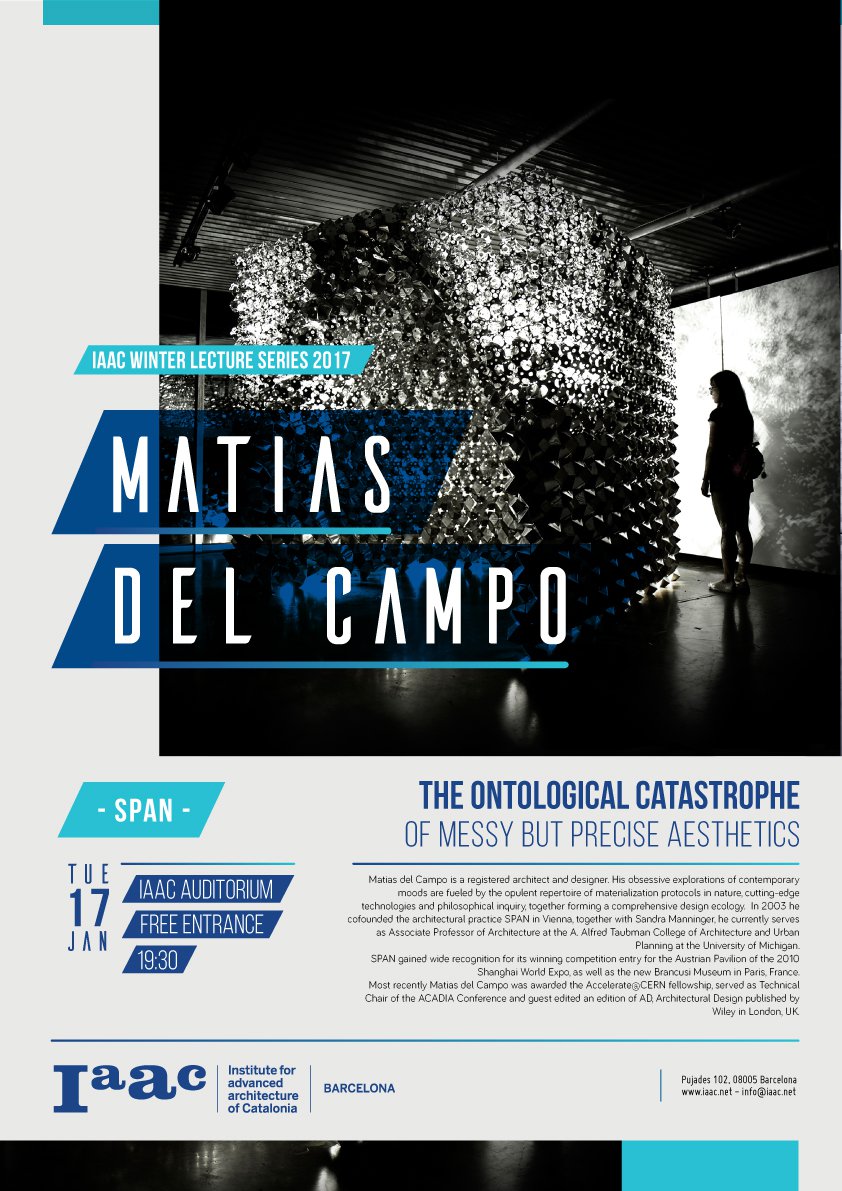
Matias del Campo Lecture

IAAC LECTURE SERIES 2017 MATIAS DEL CAMPO

Matias del Campo is a registered architect and designer. His obsessive explorations of contemporary moods are fueled by the opulent repertoire of materialization protocols in nature, cutting-edge technologies and philosophical inquiry, together forming a comprehensive design ecology. In 2003 he cofounded the architectural practice SPAN in Vienna, together with Sandra Manninger, he currently serves as Associate Professor of Architecture at the A. Alfred Taubman College of Architecture and Urban Planning at the University of Michigan.

SPAN gained wide recognition for its winning competition entry for the Austrian Pavilion of the 2010 Shanghai World Expo, as well as the new Brancusi Museum in Paris, France. Most recently Matias del Campo was awarded the Accelerate@CERN fellowship, served as Technical Chair of the ACADIA Conference and guest edited an edition of AD, Architectural Design published by Wiley in London, UK.

blank

IAAC Lecture Series 2016/17

Tuesday 17th of January 2017
Matias del Campo
SPAN

The Ontological Catastrophe of Messy but Precise Aesthetics

@ 19.30, IAAC Auditorium
Open to the Public

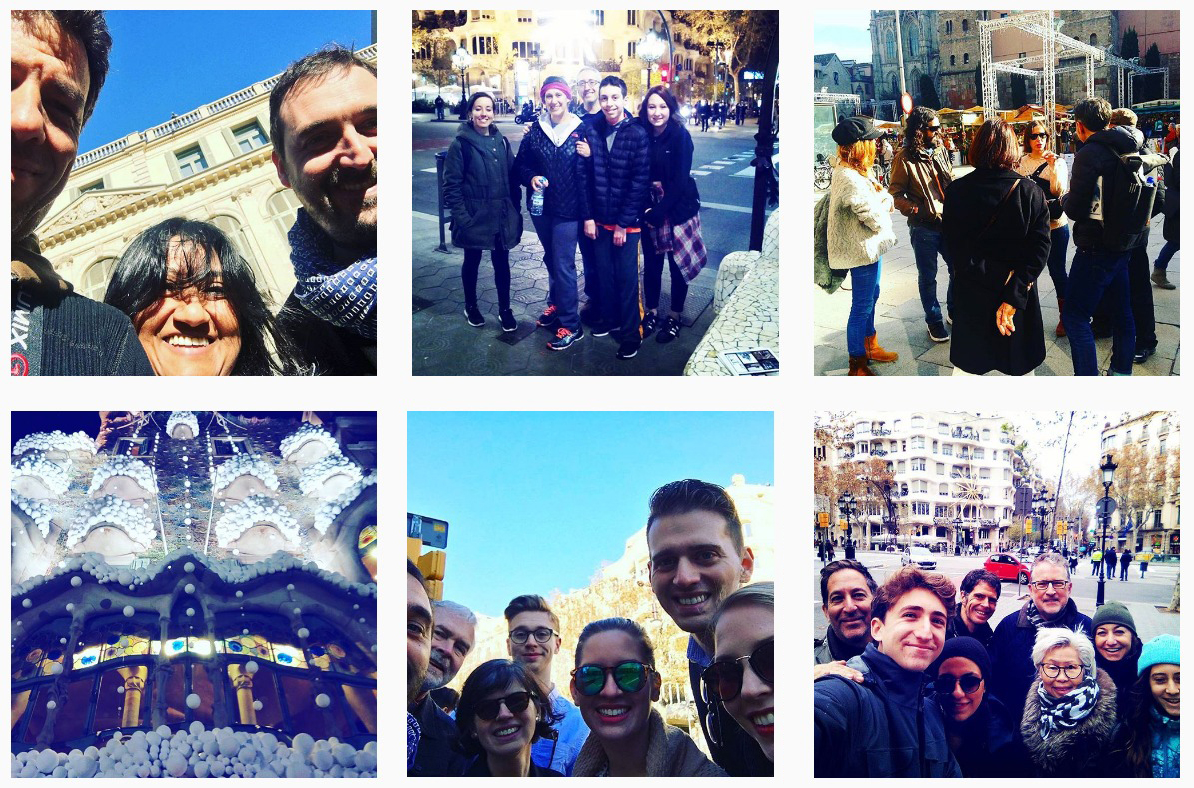
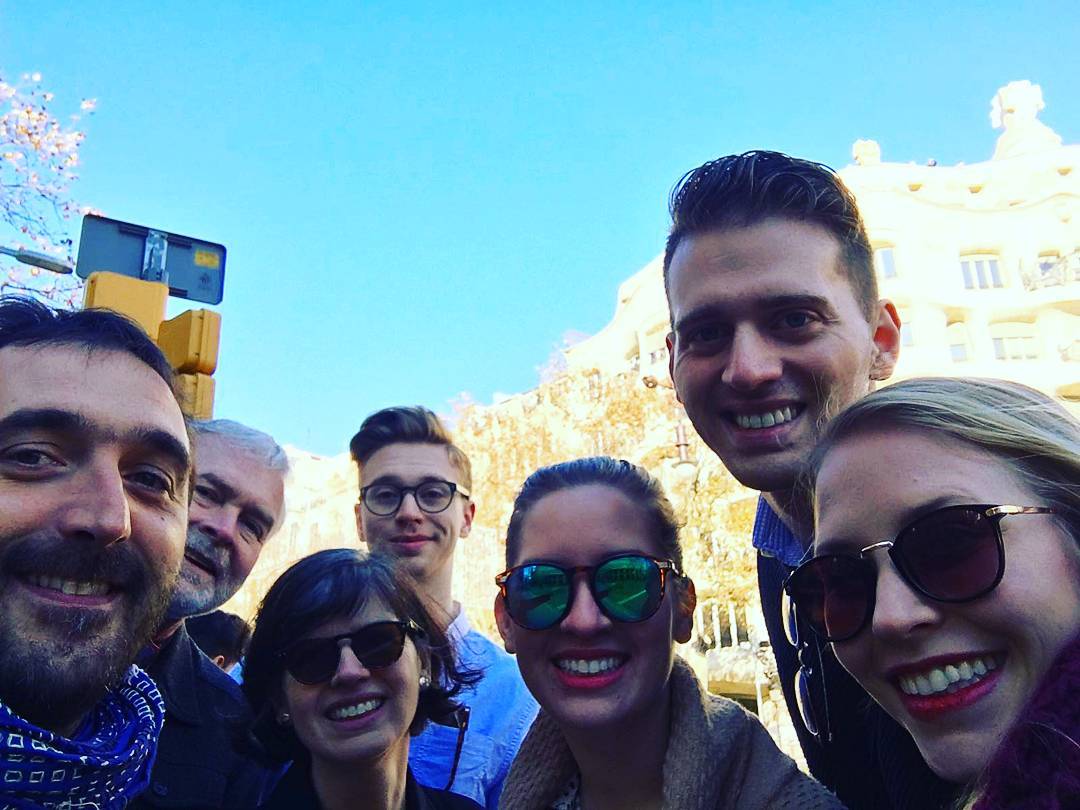
Pictures from amazing Walks

Walks on Christmas time!

Today we share with you a series of nice pictures from our Xristmas walks.

We are very happy about many travelers have been walking with us on these weeks and enjoyed Barcelona through our Walking Tours…

It was a pleasure!

blank

Walk with us and immerse yourself in a city that will not leave you indifferent.

blank

We remind you that we continue with our walking tours as usual:

BARCELONA & GAUDI a great start to discover the genius of Gaudí.

& THE SEA  discover Barcelona through its architecture.

& THE FUTURE CITY walk through the smart city looking for our Future and discover with us the new Superblock at Poblenou.

& THE URBANISM travel with us to the origins of the modern Barcelona.

& THE MARKET see Barcelona through the eyes of Enric Miralles.

COME ON GUYS LET’S WALK WITH US AND LIVE AN AMAZING EXPERIENCE!

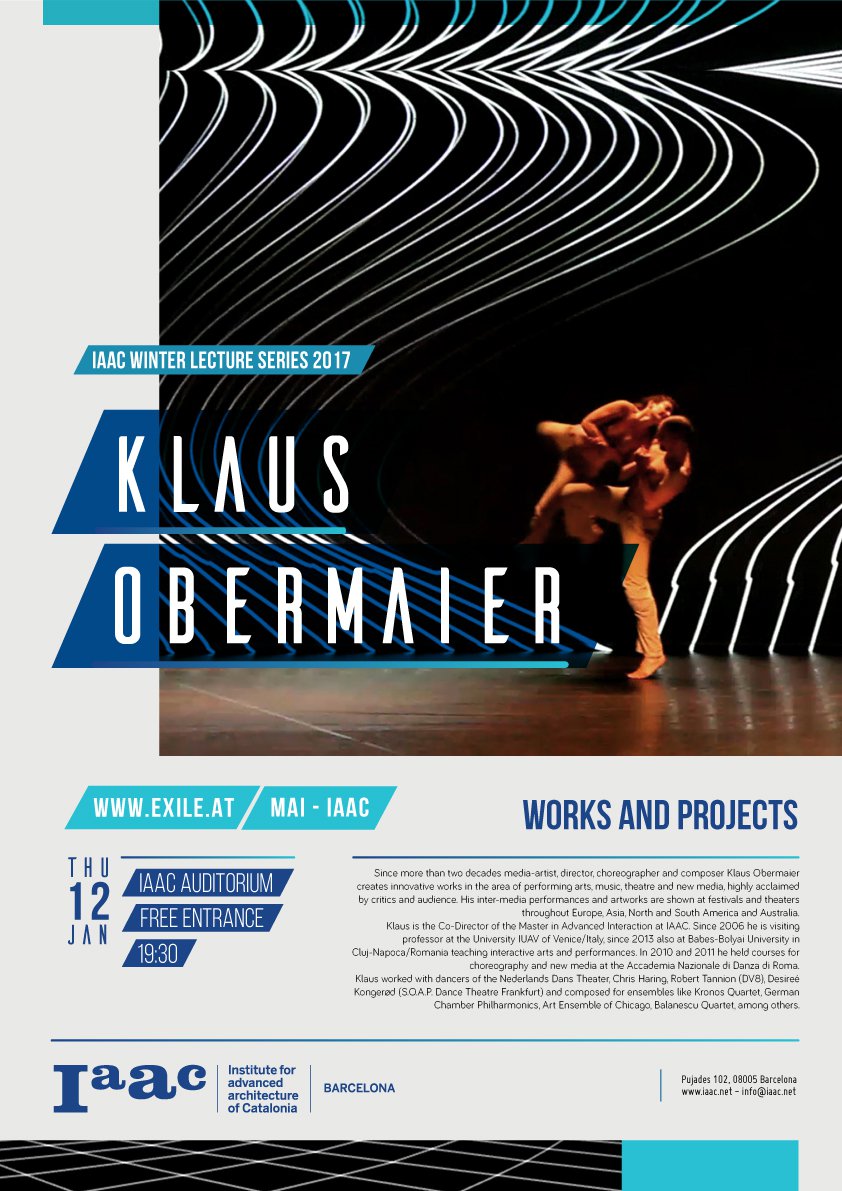
KLAUS OBERMAIER LECTURE

IAAC LECTURE SERIES 2017 KLAUS OBERMAIER

Klaus Obermaier creates innovative works with new media in performing arts, music and installations, highly acclaimed by critics and audience. His inter-media performances and artworks are shown at festivals and theatres throughout Europe, Asia, North and South America and Australia.

Klaus is the co-director of the new Master in Advanced Interaction at IAAC. Since 2006 he is visiting professor at the University IUAV of Venice/Italy, since 2013 also at Babes-Bolyai University in Cluj-Napoca/Romania teaching interactive arts and performances. In 2010 and 2011 he held courses for choreography and new media at the Accademia Nazionale di Danza di Roma.

Klaus worked with dancers of the Nederlands Dans Theater, Chris Harin, Robert Tannion (DV8), Desireé Konerød (S.O.A.P. Dance Theatre Frankfurt). He composed for ensembles like Kronos Quartet, German Chamber Philharmonics, Art Ensemble of Chicago, Balanescu Quartet, among others.

blank


IAAC Lecture Series 2016/17

Thursday 12th of January 2017

Klaus Obermaier
www.exile.at / MAI Co-director

Works and Projects

@ 19.30, IAAC Auditorium
Open to the Public

2017 Great reviews

Hi Walkers!

This week we start the year so glad about these reviews left by one of the last Walkers about our BARCELONA & GAUDI  walking tour lead by our passionate architects Ricard and Joan…

Here it is!

“Great way to get your bearings ”

Because we were a group of 6 we did a private Gaudi tour. Ricard was great, his English was excellent and he took us to all the Gaudi spots and some extras. He gave great context of Barcelona and Catalunya history and architectural history around the city. It was a really great way to determine what we wanted to see and the history of the town. I highly suggest it as your first activity and if we were here longer we would go on another tour!

blank

“Brought the history of Barcelona to life through the enthusiasm of our knowledgeable guide”

We learnt so much whilst exploring the streets of Exaimple. We would definitely recommend this, ideally as the first thing you do on arriving in Barcelona. Joan was so enthusiastic that the time flew by and we were sad to find the tour had finished. Thank you so much, Joan!

blank

More Reviews

Guys you are amazing… We love our Walkers!

We remind you that we continue with our walking tours as usual:

BARCELONA & GAUDI a great start to discover the genius of Gaudí.

& THE SEA  discover Barcelona through its architecture.

& THE FUTURE CITY walk through the smart city looking for our Future and discover with us the new Superblock at Poblenou.

& THE URBANISM travel with us to the origins of the modern Barcelona.

& THE MARKET see Barcelona through the eyes of Enric Miralles.

COME ON GUYS LET’S WALK WITH US AND LIVE AN AMAZING EXPERIENCE!


10 biggest architecture trends of 2016

The 10 architecture trends that defined 2016, from the resurgence of minimalism to the next generation of prefabs and the advent of co-living.

blank

Minimalist interiors

This year we saw an abundance of austere interiors – from apartments and bathrooms to offices – finished with cool-toned marble, uniform woodwork and block coloured walls.

Among them is a Barcelona apartment with grey-veined marble and raw concrete surfaces by Raúl Sánchez and the bathroom created by Maayan Zusman in a Tel Aviv apartment, where the only accents are a blood-red tap and a black-framed sink stand.

blank

Prefabricated houses

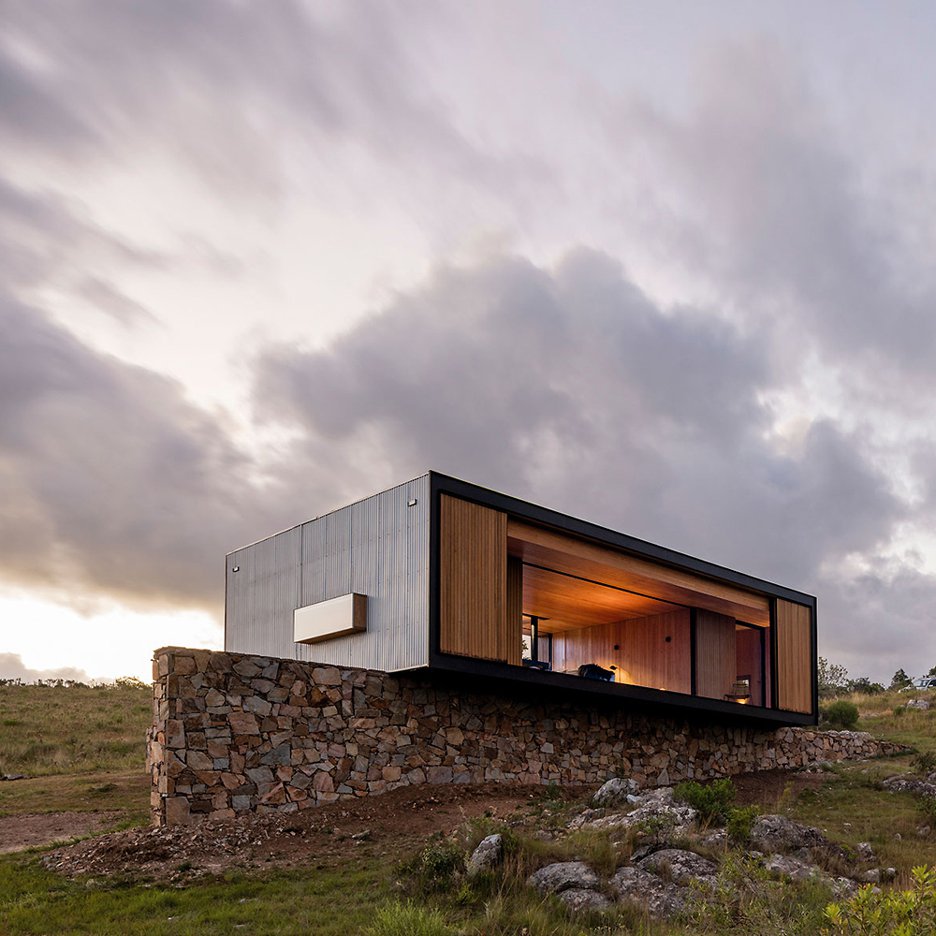
This year prefabs shook off their makeshift reputation, with architects and designers considering how modular building techniques could be used to build speedy and cost-effective yet aesthetically pleasing long-term housing.

One Uruguayan example by MAPA sits over stone walls in an olive grove, while Japanese design brand Muji began testing its Kengo Kuma-designed prefab house.

In England, ShedKM and Urban splash are creating a whole development of modular housing, and in Estonia Kodasema created a tiny cubic living space that allows its owners to up sticks and move on a whim.

blank

Co-living

Over the last year, co-living and co-working schemes have attempted to completely reinvent how people live and work, with shared office and housing blocks largely targeting cash-strapped millennials.

But co-living was also presented as the ideal housing solution for an ageing population and the UK’s first dedicated older co-housing scheme completed in London.

One co-living developer even predicted the popularity of the trend would make us all homeless in the future.

blank

Charred timber

The Japanese wood-preservation technique known as shou sugi ban has been used to blacken the cladding of hotels, houses, pavilions and studios the world over.

We featured 35 projects incorporating the technique in 2016. Snøhetta selected the treatment for a cabin set in the crown of huge pines in Sweden, while Studio Padron covered a tiny library and guesthouse in upstate New York in blackened planks and Stal Collectief burnt the moving timber walls of its studio in the Belgian countryside.

blank

London house extension boom

A thirst for contemporary design transformed the London extensions market in 2016, with architects exploring ever more ambitious ways to expand tight living spaces in the capital.

The couple behind Scenario Architecture added a glass-roofed extension to their own London home, while Studio 304’s sunken washroom allows residents to bathe in a garden setting and Selencky Parsons’ stepped extension to a 1960s terrace diminishes in size like Russian dolls.

More


Five ways to plan the cities of the future

In 2009, UN Habitat estimated that 3m people were moving to cities every week. An expert panel shares their thoughts on planning the cities of the future.

blank

1  Involve all urban residents, including slum-dwellers, in planning their own cities

Despite the excellent work leading up to Habitat III and the adoption of the New Urban Agenda, we continue to see certain groups and individuals living in our cities that are not able to participate in negotiations. Slum dwellers are one such group. We need to speak to the most marginalised in ways that articulate their everyday realities. When ever we have taken the time to do this, we find they are the experts of their own condition – they do not make unreasonable demands and they are prepared to make the trade-offs needed to make the city work. Jaideep Gupte, co-leader of the cities cluster at the Institute of Development Studies, University of Sussex.

A recent study found that religious minorities, recent migrants and people living in poor neighbourhoods and slums, of the Indian cities surveyed, lack municipal governance and institutions that enable access to services such as all-weather roads, drainage, sanitation and reliable drinking water. Structurally-exclusionary decision-making processes reinforce patterns of inequity that determine who suffers during, for example, extreme climate events. Timon McPhearson, assistant professor of urban ecology, environmental studies, The New School.

2  Design cities that protect the needs of older people

Many think that cities are places for the young to find work and forget that an increasing proportion of the urban population is growing old. People aged over 60 actually represent the fastest growing cohort of urban populations. We need to look beyond design and basic physical accessibility and consider whether the shared and public spaces of our cities – streets, roads, squares and parks – are actually pleasant places. For example, you could make a street physically accessible by designing ramps, railings, signage but if the space is overwhelmed by fast moving vehicles, thick pollution and narrow pavements, it’s not a space people would want to be in. Unless people have to go out, they will stay at home, seeing friends and family less, accessing services less frequently and, in the end, risk loneliness and social isolation. Sion Jones, urbanisation policy officer, HelpAge International.

3  Put resilience thinking at the heart of city planning

Until recently, rivers in the San Salvador flooded regularly, sometimes with devastating consequences for people living on the banks. Some years back a bridge was washed away with a whole bus full of people. Unops [UN office for project services] rebuilt the bridge, enforced the banks, and redesigned the gorge so that it will withstand future flash floods. Grete Faremo, undersecretary general and executive director, UNOPS.

4  Pay attention to what women need

In the New Urban Agenda there are several mentions on how to address the needs of women and other vulnerable population groups: age, gender and environment-responsive solutions within the continuum of land and property rights [and] security of land tenure for women; and urban life without fear of violence and intimidation and recognising the working poor – particularly women – in the informal economy, including the unpaid, domestic, and migrant workers to the urban economies. Addressing issues such as land rights, housing, informality and urban violence in a more strategic way to address women’s, older and vulnerable people’s needs is fundamental. Anaclaudia Rossbach, regional adviser for Latin America and the Caribbean, Cities Alliance.

We have to focus on directing funds to the most vulnerable sectors with integral policies, not only for housing or services, but also for social activities and culture. The priority has to be where the inequality aggravates most. Fernando Duarte, TECHO International, leading the department of development of habitat.

Women experience the lack of services in a particular way. The threat of violence [is] limiting women’s mobility in the urban space. This includes violence experienced while accessing services on public transport, fetching water from a common water point, navigating through poorly-lit neighbourhoods and even at police stations where they go to report such violence. On top of that, when governments fail to deliver services like water, childcare and hospitals it is women who subsidise them through their care work. Wangari Kinoti, women’s rights policy manager, Action Aid International.

We need to make sure girls have the same opportunities, schools need to be built for both genders in the first place. It’s not only about the teachers; it’s about the facilities, the sanitation, the involvement of the local communities. Grete Faremo

5  Share stories of positive action

We need to gather and share examples of positive visions and actions on the ground. To meet the real social, ecological, economic and technical-infrastructural challenges we face, we need to scale up those actions, narratives and visions that are seeds of a positive future. The Good Anthropocenes project is collecting positive sustainability actions from around the world as both a research project, but also as a knowledge sharing platform.

More
Entrevista Barcelona Architecture Walks

Aquí tenéis una entrevista que nos han hecho desde TREKKSOFT, nuestra nueva plataforma de reservas y pagos…. que ya cumplimos 6 añazos en esto de contar historias!!!!!

es_barcelona_walk_spotlight

Spotlight: Barcelona Architecture Walks Descubriendo la ciudad con ojos de arquitecto

Miguel Ángel Borras es socio y cofundador de Barcelona Architecture Walks, una propuesta que, desde hace seis años, invita a descubrir Barcelona con los ojos de un arquitecto. Desde entonces, han recibido el Certificado de Excelencia de TripAdvisor (2013, 2014, 2015 y 2016) y han sido nombrados entre los 5 mejores tours de arquitectura del mundo. Descubre más acerca de su éxito y déjate inspirar por su historia.

¿Cómo surge la idea de realizar estos tours?

Esta historia empieza con un viaje que hicimos a Australia en 2009, porque nos interesaba la posibilidad de vivir allí. Al final, este plan no salió, pero volvimos con unas cuantas ideas para refundar nuestro despacho: MIEL Arquitectos. Y entre esas ideas estaban las Barcelona Architecture Walks.

La verdad es que nunca nos habían interesado este tipo de tours. Pero cuando estuvimos en Sidney, quisimos conectar con la red de arquitectura local y nos recomendaron que hiciéramos el tour Sydney Architecture Walks sobre el edificio de la Ópera de Sidney, con Eoghan Lewis. Y la verdad es que nos sorprendimos. Para mí, un tour era una persona recitando un texto que había aprendido, sin interacción con el público. Por eso, este tour nos fascinó. No se trataba solo de dar datos: era una clase de divulgación arquitectónica. Y la gente reaccionaba de una forma impresionante.

Y esta experiencia os inspiró…

Cuando volvimos, decidimos intentar hacer eso mismo en Barcelona. Al principio, probamos hacerlo en torno a la figura del arquitecto que más nos impresiona: Enric Miralles y su reforma del Mercado de Santa Caterina. Tras seis meses de haber empezado, y sin haber obtenido una sola reserva, decidimos que era hora de ofrecer un tour relacionado con Gaudí. Pero no con el mismo enfoque de siempre, sino que queríamos dar una visión más profunda y entendible de quién era Gaudí. Era, en realidad, una excusa para divulgar la historia, la cultura, la política de Barcelona.

bawjoan

En 2014, Barcelona Architecture Walks fue mencionado por The Sydney Morning Herald como uno de los 5 mejores tours de arquitectura del mundo… ¿a qué se debe este triunfo? ¿qué diferencial de marca ofrecéis a vuestros clientes?

El diferencial es que nos apasiona lo que hacemos y no necesitábamos que fuera rentable para abocar todas nuestras energías en ello. Entramos en Trekksoft para empezar a rentabilizar un poco más nuestros esfuerzos. Pero hasta ahora ha sido primordialmente un hobby, ha sido un lujo que venga un turista y que nos quiera escuchar. Cada uno de estos tours es como si te fueras a tomar una copa con alguien que quiera escuchar una historia bonita. Intentamos hacer eso con Barcelona. Y conseguimos que miren diferente, con los ojos de un arquitecto. Ofrecemos una experiencia distinta: queremos que entiendan, que comprendan, que interioricen. Eso es lo que ha generado nuestros buenos resultados en portales como TripAdvisor.

Por otra parte, habitualmente la divulgación de arquitectura se hace entre universidades de arquitectura y tiene un coste muy elevado (hemos visto que cuestan 500 euros, mínimo). Nosotros tenemos este servicio a bajo coste. Aquí en Barcelona hay otros tours que enseñan arquitectura, pero no brindados por arquitectos ni desde la forma de pensar del arquitecto. Con nosotros, por 35 euros, tienes a un arquitecto dos horas y media hablando contigo. Y puede ser una experiencia removedora. Sin ir más lejos, en Sidney, una persona que yo no había conocido en mi vida (Eoghan Lewis) me hizo reflexionar sobre la forma en la que habíamos estado trabajando durante 8 años.

bawricard

Leer más


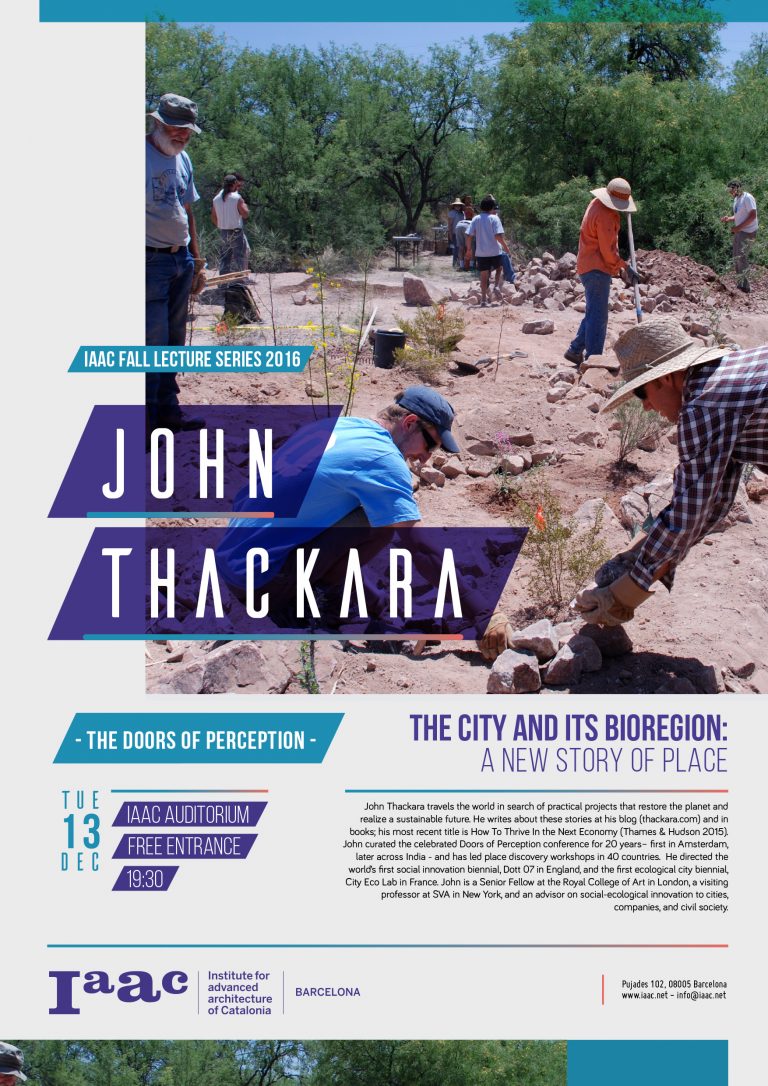
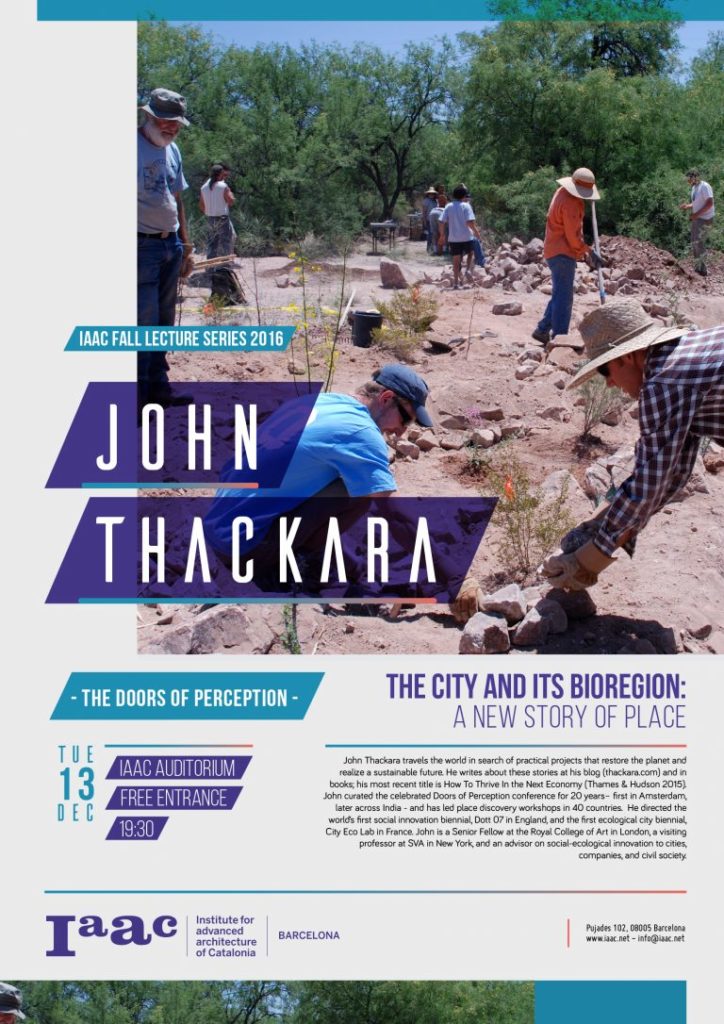
JOHN THACKARA LECTURE

IAAC Lecture Series John Thackara

John Thackara travels the world in search of practical projects that restore the planet and realize a sustainable future. He writes about these stories at his blog (thackara.com) and in books; his most recent title is How To Thrive In the Next Economy (Thames & Hudson 2015).

John curated the celebrated Doors of Perception conference for 20 years – first in Amsterdam, later across India – and has led place discovery workshops in 40 countries. He directed the world’s first social innovation biennial, Dott 07 in England, and the first ecological city biennial, City Eco Lab in France. John is a Senior Fellow at the Royal College of Art in London, a visiting professor at SVA in New York, and an advisor on social-ecological innovation to cities, companies, and civil society.

johnthackaralecture

IAAC Lecture Series 2016/17

Tuesday 13th of December 2016

John Thackara

The Doors of Perception

The City and its Bioregion: a New Story of Place

@ 19.30, IAAC Auditorium

Open to the Public

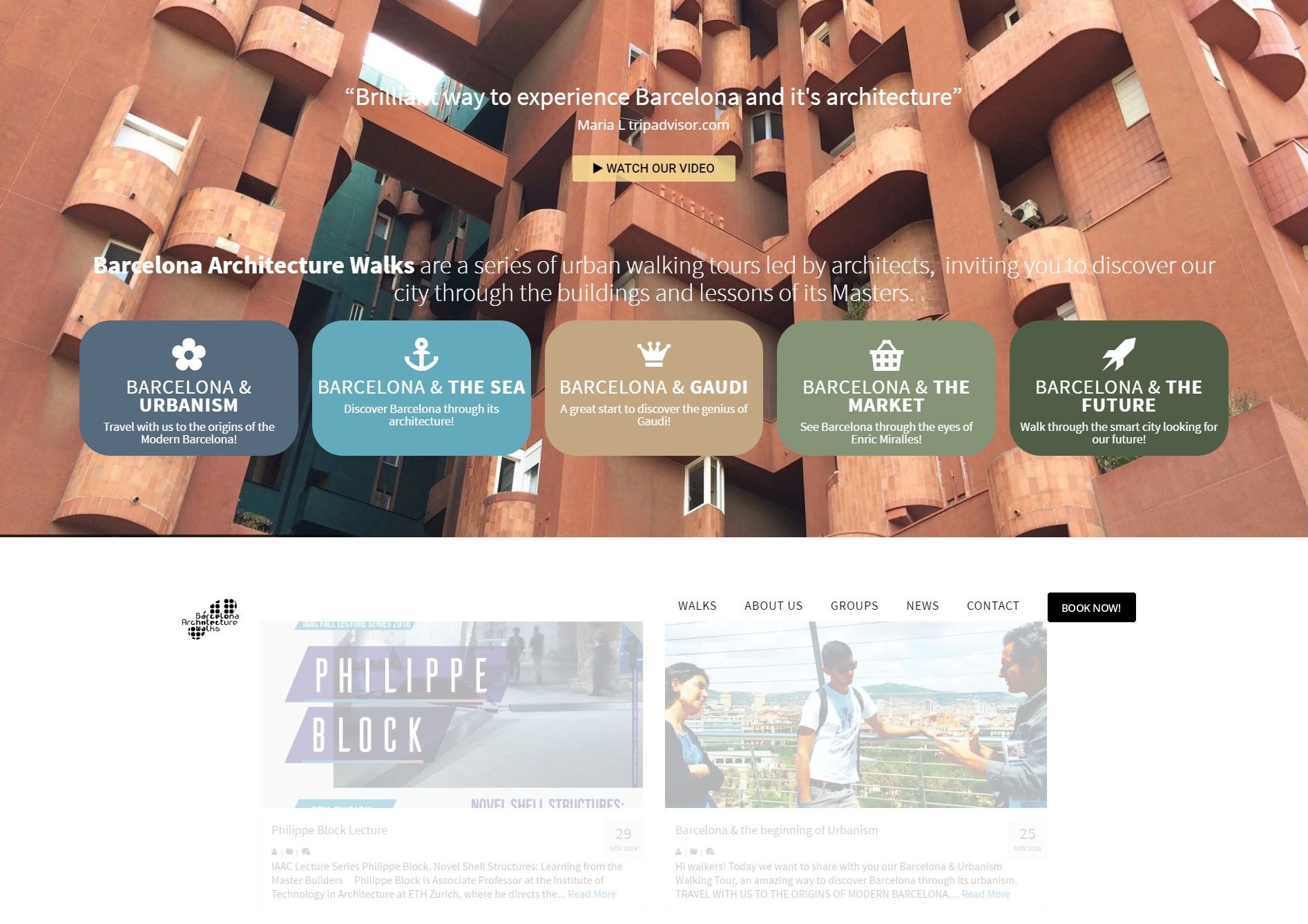
Barcelona Architecture Walks new website

Hi walkers we have new website!

We are very happy! Barcelona Architecture Walks have a brand new website with new look, pictures, and with a fresh interface!
And the most important is we have a new booking reserver sistem, secure, fast and reliable.
What else?

welcome-to-barcelona-architecture-walks-baw


It looks nice, isn’t it?

Take a look here

We remind you that we continue with our walking tours specially on Christmas time:

BARCELONA & GAUDI a great start to discover the genius of Gaudí.

 & THE SEA  discover Barcelona through its architecture.

 & THE FUTURE CITY walk through the smart city looking for our Future and discover with us the new Superblock at Poblenou.

 & THE URBANISM travel with us to the origins of the modern Barcelona.

 & THE MARKET see Barcelona through the eyes of Enric Miralles.

COME ON GUYS LET’S WALK WITH US AND LIVE AN AMAZING EXPERIENCE!


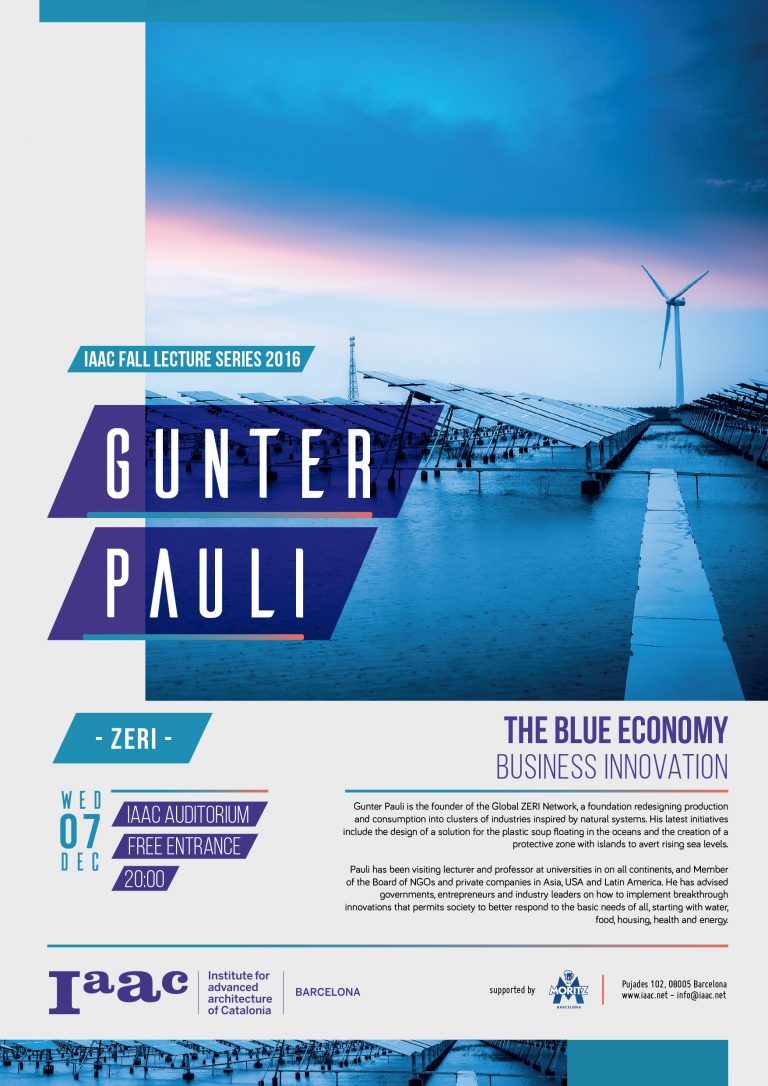
GUNTER PAULI LECTURE

IAAC Lecture Series Gunter Pauli

Gunter Pauli is the founder of the Global ZERI Network, a foundation redesigning production and consumption into clusters of industries inspired by natural systems. His latest initiatives include the design of a solution for the plastic soup floating in the oceans and the creation of a protective zone with islands to avert rising sea levels.

Pauli has been visiting lecturer and professor at universities in on all continents, and Member of the Board of NGOs and private companies in Asia, USA and Latin America. He has advised governments, entrepreneurs and industry leaders on how to implement breakthrough innovations that permits society to better respond to the basic needs of all, starting with water, food, housing, health and energy.

lecture_pauligunter

IAAC Lecture Series 2016/17

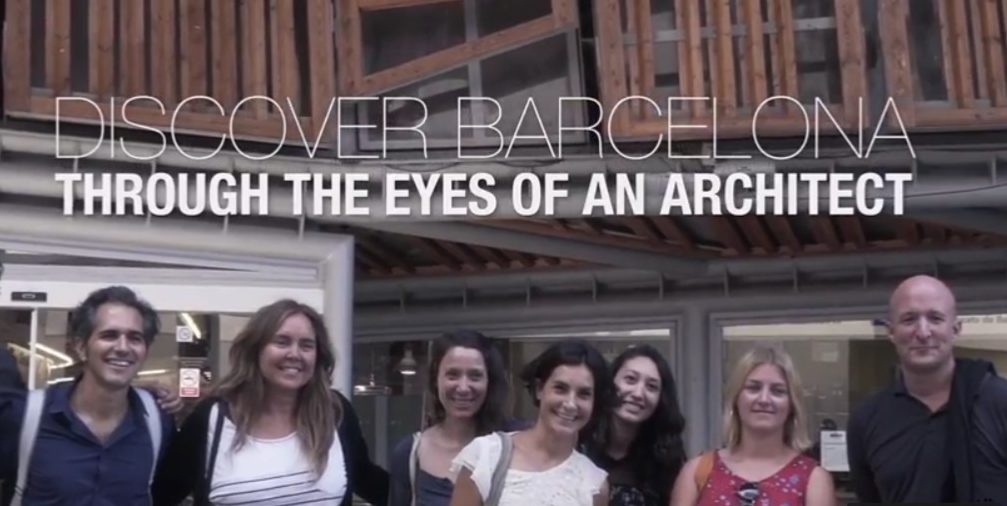
BAW Promo Video

Here it is our first Promo Video!

Today we share with you our first Promo Video by @dosbcnstudio here you have our story…

A couple of Architects, an incredible city, and one dream… This is the beginning of our adventure Barcelona Architecture Walks.
A series of Walking Tours that will immerse you in the spirit of Barcelona lead by a PASSIONATE ARCHITECT.
DISCOVER Barcelona in a different way, ENJOY its secrets and insights.
WALK to understand its streets and the way the city was formed.
CHAT to meet the Masters and architects who contributed with their work to the city we know today.
UNDERSTAND our amazing city.
DISCOVER BARCELONA THROUGH THE EYES OF AN ARCHITECT.
Walk with us and immerse yourself in a city that will not leave you indifferent.

Meet the spirit of the city that dazzles many visitors and that we’re in love with.

We remind you that we continue with our private walking tours specially on Christmas time:

BARCELONA & GAUDI a great start to discover the genius of Gaudí.

 & THE SEA  discover Barcelona through its architecture.

 & THE FUTURE CITY walk through the smart city looking for our Future and discover with us the new Superblock at Poblenou.

 & THE URBANISM travel with us to the origins of the modern Barcelona.

 & THE MARKET see Barcelona through the eyes of Enric Miralles.

COME ON GUYS LET’S WALK WITH US AND LIVE AN AMAZING EXPERIENCE!


Philippe Block Lecture

IAAC Lecture Series Philippe Block.

Novel Shell Structures: Learning from the Master Builders

Philippe Block lecture


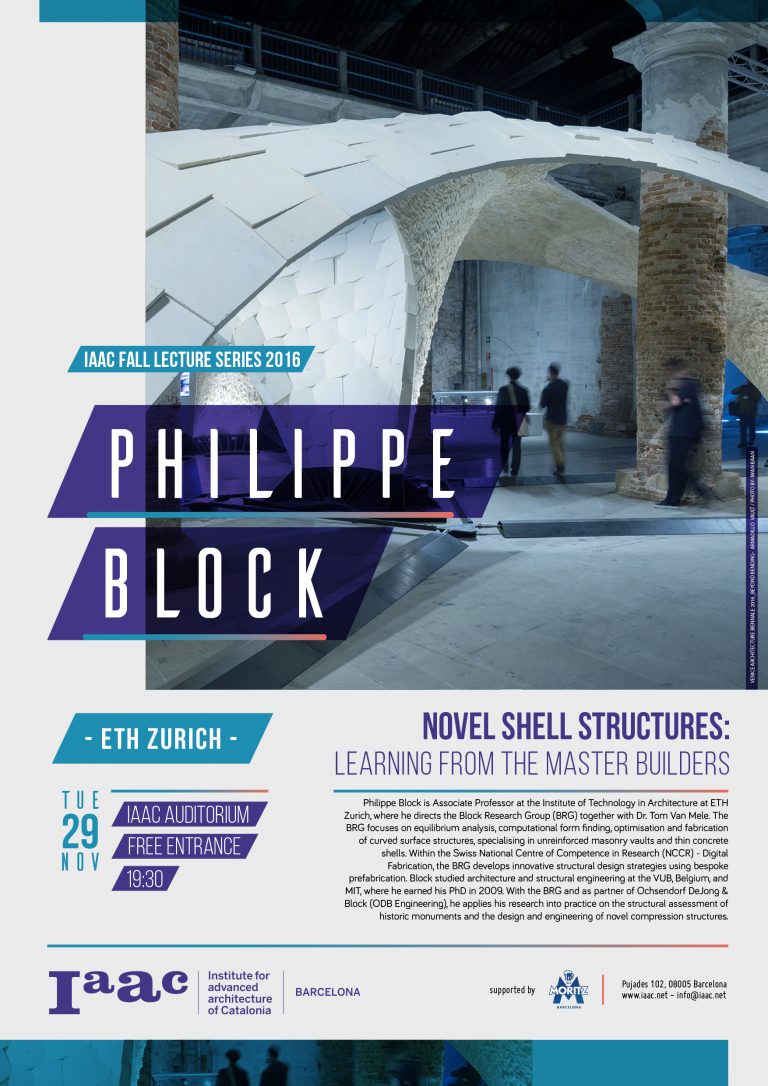
Philippe Block is Associate Professor at the Institute of Technology in Architecture at ETH Zurich, where he directs the Block Research Group (BRG) together with Dr. Tom Van Mele. The BRG focuses on equilibrium analysis, computational form finding, optimisation and fabrication of curved surface structures, specialising in unreinforced masonry vaults and thin concrete shells.

Within the Swiss National Centre of Competence in Research (NCCR) – Digital Fabrication, the BRG develops innovative structural design strategies using bespoke prefabrication. Block studied architecture and structural engineering at the VUB, Belgium, and MIT, where he earned his PhD in 2009. With the BRG and as partner of Ochsendorf DeJon & Block (ODB Engineering), he applies his research into practice on the structural assessment of historic monuments and the design and engineering of novel compression structures.

IAAC Lecture Series 2016/17

Tuesday 29th of November 2016
Philippe Block
ETH Zurich

Novel Shell Structures: Learning from the Master Builders

@ 19.30, IAAC Auditorium
Open to the Public

×