Superblocks post-car urban living

Barcelona Superblocks can demonstrate how to create tight-knit urban communities.

The most exciting question raised by the Barcelona superblocks project is not how to push cars out of an area, but what happens next — what becomes of the newly liberated space, and what might become of a whole network of such spaces. It is in contemplating this question that the true depth of urban visionary Salvador Rueda’s ambition becomes clear.

Superblocks’ plan for Barcelona, now adopted by the city, is based on design principles and metrics he shares in his “charter for the ecosystemic planning of cities and metropolises” and his book Ecological Urbanism. It is the contemporary analogue of Ildefons Cerdà’s plan for the city in the 19th century, reflecting the same holistic perspective and humanistic goals, as well as similar morphology and geometry. It is, one might say, Cerdà on steroids. Supercerdà.

Its true nature will only become clear when there are more superblocks in place — when they begin to constitute a network, and exhibit network effects — but suffice to say, the plan involves much more than reducing traffic.

blank

Superblocks transform single-use spaces to multi-use spaces

The basic idea behind the superblocks plan is to take urban surface space now devoted to one use (automobile traffic) and open it up to multiple uses (walking, cycling, hanging out, what have you). The only way to do that is to exclude vehicle traffic.

blank

The challenge when implementing superblocks, then, is to preserve adequate circulation of people, goods, and services using fewer vehicles on fewer streets, that will mean moving people into other means of getting around, like buses, bikes, and feet. And it will mean channeling the vehicle traffic that remains — buses and (hopefully someday electric, shared) cars — onto fewer orthogonal through routes.

“From the street grid in the city, we select those streets that maintain the conditions for transversal mobility,” says Ton Salvadó, Barcelona’s chief architect, “and the rest of the streets are calmed.”

blank

Within the area of the superblock, streets are one-way, and none of them pass straight through. Cars are limited to about 10 kph, not much more than walking speed, so they can mix safely with human beings. Parking for residents is mostly underground (as it is in the Poblenou superblock), so there’s no surface area devoted to it.

Another way of putting this is that streets inside the superblock become shared, mixed-use public space. Different superblocks in different neighborhoods using their public spaces differently, for outdoor concerts, parties, sports, playgrounds, gardens, green spaces, or just areas for gathering (with picnic tables).

blank

“The people will be different, the relations between them will be different, and the uses of public space will be different,” Rueda says. “I’m waiting for something like that. The evolution of our city will be very rich.”

The “social superblock” will be more than a traffic-calmed area

Each superblock could have a shared distribution center for goods and packages, so that delivery vans don’t have to drive inside; shared gardens for growing community food, with organic waste captured for compost; a shared clinic for health and social services, so that day-to-day health care needs could be handled by a familiar doctor and the elderly or disabled wouldn’t be forced to move out of their apartments to find care.

blank

Rueda prefers to think of a city as an ecosystem that relies for health on the proper “system of proportions”: a variety of legal entities, from commerce to social services to civic and recreational facilities; a variety of different uses of space and modes of transport; and a variety of people of different ages, races, and social classes. Machines succeed through efficiency; ecosystems succeed through fecundity.

blank

The main goal is: make cities and a city starts to be a city when you have public space. That requires less space devoted to cars and more devoted to people mingling, playing, and living together, in human-scale communities. It will take time and investment, over successive city administrations, for superblocks to become social superblocks.

More

This is part of a series about the comprehensive urban plan being implemented in Barcelona, which would reclaim more than half the streets now devoted to cars for mixed-use public spaces, or “superblocks.” This reporting project was supported by the Kleinman Center for Energy Policy at the University of Pennsylvania, where the author, David Roberts, is a senior fellow.

Barcelona superblocks

Barcelona’s car-free ‘superblocks’ could save hundreds of lives

Barcelona could save hundreds of lives and cut air pollution by a quarter if it fully implements its radical superblocks scheme to reduce traffic, a new report claims.

A study carried out by the Barcelona Institute for Global Health calculates that the city could prevent 667 premature deaths every year if it created all 503 superblocks envisaged in its initial plan – up from the current six schemes.

blank

The Eixample district of Barcelona, Spain. Photograph: Alamy

The superblocks are groups of streets where traffic is reduced to close to zero, with the space formerly occupied by cars given over to pedestrians and play areas.

The concept is the brainchild of BCNecologia, an agency led by Salvador Rueda. The six schemes introduced so far have been generally welcomed by residents of a city whose air quality regularly exceeds the World Health Organization’s legal limits for pollutants such as nitrogen dioxide (NO2).

The report claims that creating all 503 superblocks would reduce ambient levels of NO2 by 24%, from the current level of 47 micrograms per cubic metre to 36 micrograms per cubic metre. A decrease on that scale would bring Barcelona’s NO2 levels into line with the WHO recommendation of a maximum of 40 micrograms per cubic metre.

blank

The life expectancy of the average Barcelona resident could increase by almost 200 days, the report adds, saving the city €1.7bn (£1.52bn) a year. The most notable health benefits would come from reductions in air pollution (preventing 291 premature deaths a year), followed by reduced traffic noise and heat island effects (preventing 163 and 117 premature deaths respectively).

The study also estimates that the total of 1.19m journeys in private vehicles would fall by 230,000 a week as people switched to public transport or making journeys on foot or by bicycle.

The plan would also increase the number of green spaces in what is a densely populated city with few public parks. In the Eixample district alone, researchers calculate that the increase in vegetation resulting from the plan would prevent 60 premature deaths a year.

“It is important to remember that the data we present are estimates and that the methodology used has certain limitations,” said Natalie Mueller, lead author of the study. “This means that our findings must be interpreted with caution. Nevertheless, irrespective of the specific figures, what this study shows is that urban planning and transport interventions like the superblocks have significant implications for public health.”

blank

The Poblenou Superblock

Mueller said Barcelona needs not just superblocks but other complementary strategies designed to improve air quality, promote physical activity and tackle climate change.

“We urgently need a paradigm shift away from the car-centred urban planning model and towards a people-centred approach,” she said.

When the first superblock was introduced in 2017 in Poblenou, in the north of the city, it was met with opposition by car owners and also those who claimed it would be ruinous to local business.

However, opposition has faded as residents have begun to enjoy the benefits of a traffic-free neighbourhood. There are also 30% more local businesses than previously and the area has seen a significant increase in the numbers of people making journeys on foot or cycling.

blank

Assembly at the Poblenou Superblock

The superblocks model has attracted attention from other cities, and in Seattle in the US there is a proposal to introduce something akin to the Barcelona scheme in a six-block area in the Capitol Hill neighbourhood.

The north-west US city has already experimented with something similar with its Home Zones project, in which residents are offered grants to introduce traffic-calming schemes.

More

What New York Can Learn From Barcelona’s ‘Superblocks’

Barcelona’s ‘Superblocks’

Imagine if streets were for strolling, intersections were for playing and cars were almost never allowed.

While it sounds like a pedestrian’s daydream, and a driver’s nightmare, it is becoming a reality here in Spain’s second-largest city, a densely packed metropolis of 1.6 million on the Mediterranean. Ever since the 1992 Summer Olympics focused global attention here, this thriving center of tourism, culture and business — often viewed as a hipper, more easygoing cousin to Madrid, the Spanish capital — has seen its popularity soar along with congestion on its streets and sidewalks.

So in an initiative that has drawn international attention and represents a transformative remaking of its streetscape, Barcelona has decided that many of its car-clogged streets and intersections will hardly have cars at all. Instead, they will be turned over to pedestrians.

Beginning in September, city officials started creating a system of so-called superblocks across the city that will severely limit vehicles as a way to reduce traffic and air pollution, use public space more efficiently and essentially make neighborhoods more pleasant.

blank

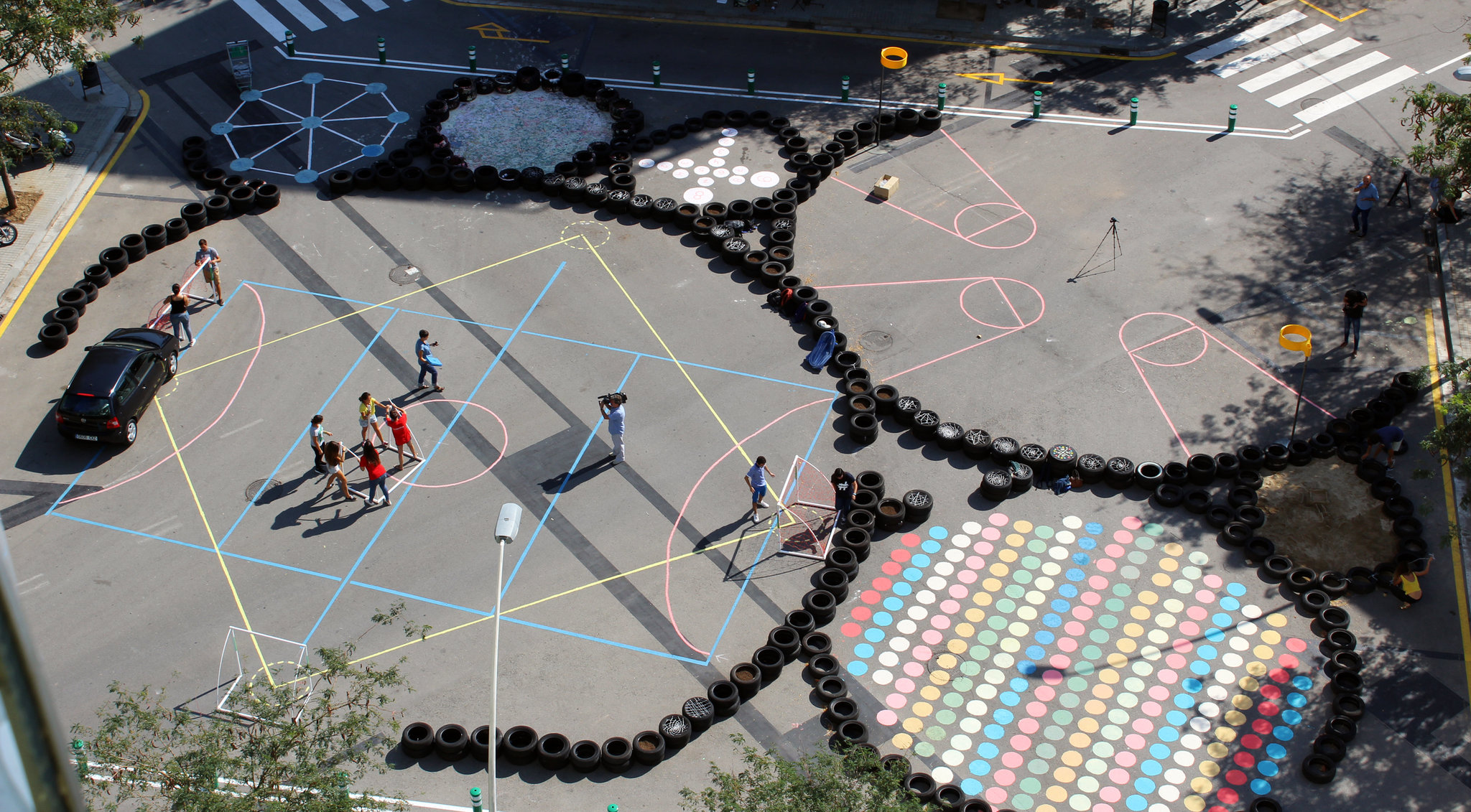
An intersection in El Poblenou, a section of Barcelona, that was transformed into a playground with a soccer field and sandbox.CreditConfederación de Talleres de Proyectos de Arquitectura (Confederation of Workshops of Architecture Projects)

“We like to call it ‘winning back the streets for the people,’” said Janet Sanz Cid, a deputy mayor of the city. “People from Barcelona want to use the streets, but right now they can’t because they are occupied by cars.”

Under the plan, the superblocks will be overlaid on the existing street grid, each one consisting of as many as nine contiguous blocks. Within each superblock, streets and intersections will be largely closed to traffic and used as community spaces such as plazas, playgrounds and gardens. Ms. Sanz said that at least five superblocks were expected to be designated by 2018.

Barcelona’s system of superblocks — called “superilles” in Catalan — would go well beyond the pedestrian plazas that have sprouted up on the streets of New York City. While those spaces have carved out more room for pedestrians in busy corridors, the superblocks represent a more radical approach that fundamentally challenges the notion that streets even belong to cars.

The strategy has propelled Barcelona, a city better known for its soccer team and its Gaudí architecture, to the forefront of urban-transportation experiments and has attracted interest from transportation officials, urban planners and advocates in many other cities paralyzed by gridlock.

Claire Weisz, an urban designer at WXY, a Manhattan firm that redesigned the streets around Astor Place, said Barcelona’s superblock plan could be applied in New York to redefine streets as public spaces. “The vast majority of people living in our neighborhoods don’t have cars,” Ms. Weisz said. “Yet our streets are primarily used by cars, and we have a huge need for safe places to walk and bike.”

Barcelona’s plan will redirect cars, buses and commercial vehicles to streets along the perimeter of each superblock, though local residents will still be able to drive their cars at reduced speeds and park in designated areas. Deliveries will be allowed at less congested times.

But as Barcelona officials have acknowledged, introducing the superblocks will not be as easy as simply changing the rules. To be widely accepted, the plan will require a cultural shift in the way people view and use the streets.

The first of the new superblocks received a mixed reaction when it was unveiled recently in El Poblenou, a former industrial area that has been redeveloped with low-income housing and offices for technology companies. Though many residents saw the benefits of the superblock, some complained that they were not given enough time or explanation before it was put in place. Businesses have also expressed concerns that it could interfere with their work by, among other things, restricting when they can load and unload goods.

To inaugurate the superblock, architecture professors and students have worked with local associations of residents and businesses to come up with alternative uses for the street space. One intersection, using tires and recycled materials, was transformed into a playground with a soccer field and sandbox.

Marta Louro, 40, a teacher who lives next to an intersection, said the superblock would make streets safer and reduce pollution. “It gives priority to the pedestrian,” she said. “I believe it’s very important that people have space.”

But others have expressed concerns that they will have to walk farther to a bus stop, or will have a harder time using their cars or finding parking. “It’s not a bad idea,” said Oriol Sanchez, 25, a waiter who drives to work. “But for me, it’s a problem for my car.”

Visitación Soria, 78, said the superblock would not be embraced by everyone. “People like their cars,” she said. “People are already saying there’s a problem finding parking, and this will make it worse.”

blank

The plan for a superblock in the El Poblenou district.CreditDaniel Etter for The New York Times/Asier Eguilaz

No matter the merits, the debate over what a modern urban streetscape should look like, how it should function and whom it should serve has grown increasingly clamorous around the world. In New York City, whose population is at a record high of 8.5 million residents, conflicts among pedestrians, cyclists and motorists have drawn attention to busy corridors. Transportation officials have recently takensteps to expand the overtaxed promenade on the Brooklyn Bridge.

Polly Trottenberg, the city’s transportation commissioner, said that 53 pedestrian plazas had been built, in Times Square and other parts of the city, since 2007, and that another 20 plazas were under construction. In all, these plazas will total 27 acres, roughly the equivalent of 20 football fields, Ms. Trottenberg said. “It’s not an insignificant amount of space that we’ve wrestled back from the automobile,” she said.

Ms. Trottenberg said she was aware of Barcelona’s superblocks plan and would consider applying the concept in New York — if not the name. In urban planning circles, the term “superblock” has been used to refer to sprawling public housing projects in American cities. “We’re certainly formalizing things that are close to that concept,” she said. “There are a lot of different models, and there’s not a one-size-fits-all.”

The city tried a one-day “Shared Streets” test in August that promoted recreational use of a 60-block area of Lower Manhattan. The speed limit was reduced to 5 miles per hour, and people were encouraged to take to the streets alongside cars. The program was intended to expand on another initiative, “Summer Streets,” in which a section of Park Avenue south of 72nd Street and all of Lafayette Street were closed to vehicles on three August Saturdays.

Read more

Creating “Super-Blocks” in Barcelona

Barcelona is re-designing its streets.

blocks

Barcelona’s city blocks. Photo by shawnleishman/Flick

Barcelona city planners released a new plan that takes city spaces back from cars, for the people. Re-orienting the city to the human scale, Barcelona’s leaders have decided to create more space for walking and cycling, while leaving less space for traffic jams. The goal is that this transformation will increase Barcelona residents’ access to the city, with new areas for recreation and social interaction along the historic city streets.

The new plan will return 60% of the space of the streets where cars circulate today to the citizens for pedestrian use. The city has an ambitious plan for the redesign of the blocks of neighborhoods, turning them into “super-blocks.” The idea is to join nine city blocks into one, forming a square. The cars on the internal streets will be replaced by boardwalks, bike paths, recreational areas and green areas. The Eixample district will be the first to participate in the project.

The design of the “super-blocks” will humanize public space, as it takes into consideration livability, sustainable mobility, green areas and biodiversity, while aiming to promote citizen participation. Local government leaders aim to create public spaces for the people, emphasizing social interaction, health and recreation for all. The measures, in addition to benefiting residents, are aligned with urban sustainability goals. The design of “super-blocks” re-organizes city streets to be oriented toward sustainable mobility options, like walking, cycling and using public transport.

Through the new design, cars, motorcycles and buses are restricted to the streets outside the perimeter of the blocks, while private vehicles will have even greater restrictions. People who own a car and live in areas restricted to pedestrians will be able to access the internal roads, but only at reduced speeds of 10 kilometers per hour, thus reducing overall congestion and the likelihood of fatal traffic crashes. From the point of view of urban planning, Barcelona’s approach to compact neighborhoods and plans for mixed urban land use is aligned with the recommendations outlined in the Manual for Transit-Oriented Development, also referred to as DOTS. This approach enhances green spaces for citizens, encouraging social interaction and healthy modes of transport.

A study released by the Environmental Epidemiology Agency determined that last year, about 1,200 deaths could have been avoided if Barcelona met the air quality standards recommended by the European Union.  The study cites 18,700 hospital cases of preventable asthma attacks, as well as 12,100 cases of acute bronchitis and 600 hospitalizations related to cardiovascular problems. In addition, the city traffic is responsible for elevated noise levels, which have reached a level 61% higher than what is considered healthy by law.

However, the improvement of urban spaces for citizens depends on how the plan will be implemented. The project consists of adding over 300km of bike paths to existing cycling infrastructure. In addition, the city has a bus network servicing many of its main roads. Salvador Rueda, director of the Barcelona’s Urban Ecology Agency has predicted that these measures will ensure that buses have rapid and reliable service for public transport users across the city.

The new designs will be installed in nine different places across Barcelona, with an estimated project cost of €10 million. Barcelona is pioneering its urban development, using tactical urbanism to create healthier, more sustainable city spaces that are accessible to all. Returning city streets to the people, Barcelona is re-examining what a city block can be.

More

Superblocks

A sustainable strategy for regenerating the city.

superblock

(Image by Ajuntament de Barcelona)


Superilles, or Superblocks in English, is a project designed by Barcelona City Council in collaboration with the Urban Ecology Agency that aims to foster sustainable mobility, the intensive use of public spaces, biodiversity, social cohesion involving the participation of the general public, a reduced ecological footprint and, in short, which enhances the human dimension of the city. This will all be achieved by promoting a new type of urban organisation in five macro-areas specially chosen for the experiment.
What is a superblock?
This is a territorial unit that is smaller than a neighbourhood but bigger than a residential block, with calm streets where urban planning and environmental activities are held. Compact, efficient areas, that have a positive effect on the life of Barcelona residents and which are also self-sufficient in terms of energy consumption. The aim is to improve the quality of life and conditions for local residents, by rationally managing natural resources and public spaces, through the active participation of everyone involved and by fighting inequality and social exclusion.
What is going on in these superblocks?

  1. More sustainable mobility: by integrating the new Orthogonal Bus Network and Bicing in accordance with Barcelona’s Urban Mobility Plan, encouraging journeys on foot and by bicycle and improving the distribution of goods, in order to reduce both noise levels and emissions.
  2. Revitalising public areas: by making the streets quieter, increasing the number of recreational areas and promoting new uses for these places.
  3. Fostering biodiversity and urban vegetation: by improving the trees in the streets, favouring microhabitats in order to attract birds and increasing the amount of urban vegetation by creating new community areas
  4. Fostering the city’s social fabric and promoting cohesion: by guaranteeing appropriate local facilities, encouraging productive activities that create jobs and working for social inclusion.
  5. Promoting self-sufficiency in the use of resources: by reducing consumption, producing renewable energy, decreasing the demand for drinking water and making better use of greywater and river water.
  6. Integrating governance processes: by involving the general public when defining projects and developing actions.

The five superblocks have been sketched out in Les Corts, Hostafrancs, Eixample, Poblenou and in the area around Glòries.
The Les Corts superblock is one which has progressed the furthest. The zone is delimited by Travessera de Les Corts, Gran via de Carles III, Avinguda de Madrid and Riera Blanca. In this area, work has already been carried out on public spaces, with micro-urbanisation around Carrer de Benavent. The finishing touches are also being made to a crossroads that uses smart traffic lights.
The other superblocks are located in Hostafrancs (delimited by Carrer de Tarragona, Creu Coberta – Sants and Sants railway station), the Eixample (the area between the streets of París, Tarradelles/Tarragona, Gran Via and Urgell/Calabria), the new Plaça de les Glòries (the streets of Aragó, Castillejos, Tànger and Badajoz-Independència), and Poblenou (the area delimited by the streets of Bilbao, Pallars, Llacuna, Tànger and Avinguda Diagonal).

Read more


×