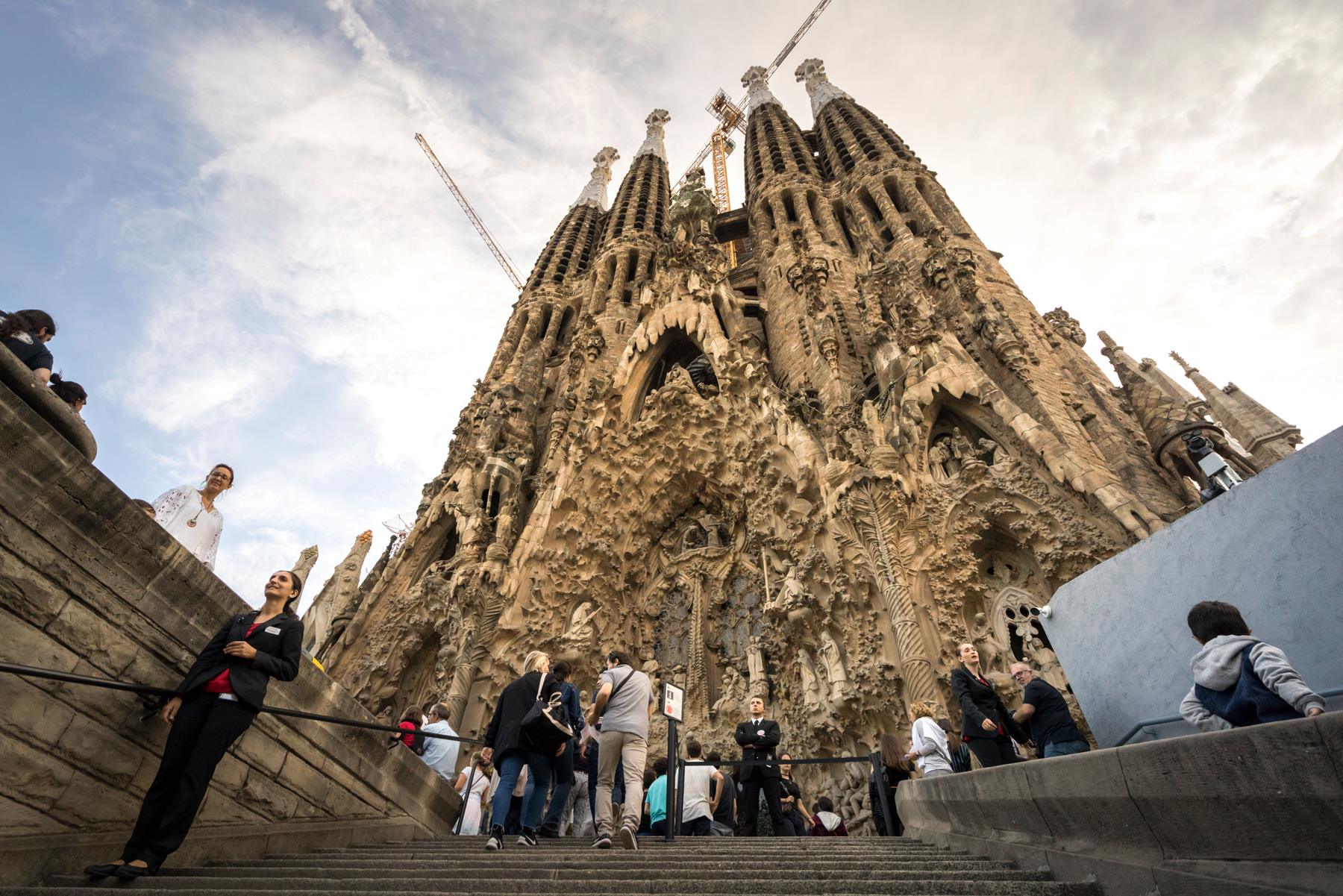
Facts about Sagrada Familia

Some facts you need to know about Gaudí’s Sagrada Familia, Barcelona’s most visited attraction

In his time, Gaudí predicted that “people would come from all over to see the Sagrada Familia,” and that the Temple would “influence art”. And this has been the case for the over one hundred years the Basilica has been under construction. Throughout this time, the Sagrada Família has welcomed visitors who have been key to raising awareness of the Temple, especially its architecture, around the world.

For 135 years, Barcelona’s Sagrada Familia has slowly been marching its way toward completion. The focal point of famed architect Antoni Gaudí’s career, the church has undergone trials and tribulations, but is finally reaching the end of construction.

Photo: Luciano Mortula – LGM / Shutterstock

An unforgettable part of Barcelona’s skyline, its multiple facades and towers are stuffed with ornate sculpture and mosaics, making it a feast for the eyes. With the project stretching on for generations, everyone from author George Orwell to architects Walter Gropius and Le Corbusier have given their opinions on the architecture. Orwell was not impressed, calling it “one of the most hideous buildings in the world.” Gropius and Le Corbusier were kinder, praising its technical perfection.

With such a complicated history, let’s look at some of the salient details about the Sagrada Familia as it marches toward the finish line.
blank

Photo: Luciano Mortula – LGM

It all started with a bookseller.

What would turn out to be Gaudí’s masterpiece started due to a bookseller’s trip to the Vatican. Josep Maria Bocabella visited Italy in 1872 and returned feeling inspired to build a church similar to one he’d seen there. Funded by private donations, construction started ten years later, in 1882.

Gaudí was not originally involved in the project.

The original architect, Francisco Paula del Villar, planned on creating a standard Gothic revival church. When he resigned one year into the project, after the apse crypt was complete, Gaudí took over, radically changing the plans.

blank

Clockwise from top left: Sagrada Familia in 1905 (Photo: Wikipedia) / Construction in 1988 (Photo: Wikipedia) / Rendering of finished church.

It’s taken longer to construct than the Great Pyramid.

Gaudí was in his early 30s when he became involved with what would become his life’s work. From about 1914 onward, he gave up all other projects in order to focus exclusively on the Sagrada Familia. At the time of Gaudí’s death in 1926, less than a quarter of the construction was finished and work only passed the midway point in 2010.

Currently, things are on track for construction to wrap up in 2026 in celebration of the centenary of Gaudí’s death. If things stay on schedule this will mean that it took 144 years to reach completion. That’s around 10 times longer than the construction of the Great Pyramid of Giza and 123 years longer than the time needed to finish the Taj Mahal.

Gaudí never worried about how long it would take.

Contrary to what one might think, Gaudí was never concerned about the pace of construction. In fact, he once said, “My client is not in a hurry.” As the architect was keenly aware that the church would take generations to complete, he kept his plans fluid, often making changes on the fly while visiting the site.

“There is no reason to regret that I cannot finish the church. I will grow old but others will come after me. What must always be conserved is the spirit of the work, but its life has to depend on the generations it is handed down to and with whom it lives and is incarnated.” This was Gaudí’s philosophy when it came to finishing his masterpiece, but not everyone agrees.

blank

Photo: Veniamin Kraskov

Gaudí is buried there.

It seems only fitting that the man who dedicated the later part of his life to the church be buried there. Dying a few days after being hit by a tram in 1926, the acclaimed architect was laid to rest in the crypt. The only other person buried in the Sagrada Familia? Josep Maria Bocabella, of course.

Technology is speeding things up.

Advances in stone cutting technology mean that pieces that were once hand-carved—a long, laborious process—can now be produced more quickly thanks to computers.

In 2015, the cathedral’s chief architect Jordi Coll implemented 3D printing technology in order to better conceptualize how new portions of the church will integrate into the older construction. “If Gaudí was alive today, he would have brought 3D technology to its maximum exponent, since much of his work was already conceived tri-dimensionally,”

blank

Photo: Yevgen Belich

Each spire holds a symbolic significance.

The original design calls for eighteen spires to symbolize the Twelve Apostles, Virgin Mary, Four Evangelists, and Jesus Christ. The spires increase in height to visually represent the hierarchy of these religious figures. When completely constructed—only eight are currently finished—the tallest spire representing Jesus Christ will give the church its full height of 560 feet. This will put it just slightly shorter than Montjuïc hill, Barcelona’s highest point. It was an intentional decision by the architect, who felt that nothing made by man should surpass what was made by God.

blank

Photo: The World in HDR

It’s the most visited tourist attraction in Barcelona.

More than 3 million people visit the Gaudí masterpiece every year. What keeps them coming back? “People are still so fascinated because there is no other place like this one in the whole world—no other contemporary church, fully paid by the people, which has an inside nave that reaches 60 meters in height,” explains Tate Cabré, author of several books about Catalan Modernism. “[It’s] a magic atmosphere to create good feelings in the visitors. They are overwhelmed and keep visiting the church every time they come to Barcelona. Sometimes you get visitors that have been in the church nine or ten times.”

Read More

LOOK here our Sagrada Familia Special tour

Sagrada Família verticality rules

The Sagrada Família: a Temple where verticality rules

The Temple of the Sagrada Família is designed based on height being dominant over the other dimensions; its composition, therefore, is vertical. In fact, one of the things that most impresses visitors is its great height inside, with columns that rise freely up to 15, 30 or 45 metres, where they meet the various vaults. These, in turn, begin 30 metres above the side naves, rising to 45 above the central nave, up to 60 above the crossing, and 75 above the apse.

blank

Gaudí choose these heights because he knew they would look lower due to perspective, which notoriously contracts dimensions at a distance. With them, the inside of the Basilica conveys a feeling of elevation, a sensation Gaudí also wanted for the outside of the Temple, which in this case comes from the lanterns that are now being built.

Gaudí really wanted to highlight this verticality and decided one lantern, as has been common in cathedrals historically, wasn’t enough; he designed six. As he explained, the lantern is the exaltation of the Temple. It has an inner and outer life. Seen from the inside, it enhances the central point of the inner space with an empty volume that lets light shine straight down on the altar, because otherwise the crossing would be the darkest part of the Temple as it is the furthest from the façades where the windows are normally located. The outside of the lantern, however, has a representational purpose, as it crowns the building and serves as a connection between earth and the heavens.  In the case of the Sagrada Família, with its grouping of lanterns and bell towers, the overall pyramidal shape of the building is further accentuated.

blank

Of all the lanterns at the Temple, the tallest is the tower of Jesus Christ, which will stand 172.5 metres above the temple floor at the crossing. Above the apse, the lantern dedicated to the Virgin Mary will reach a total height of 138 metres, and those of the Evangelists will be 135 metres tall.


BELOW BARCELONA’S MOUNTAIN

Since the first writings compiled in 1914 and 1915 by Martí Matlleu, secretary of the Junta Constructora del Temple Expiatori de la Sagrada Família and author of the collections describing the project and the works, we can see that Gaudí established the height of Montjuïc, an important element in Barcelona’s skyline, as the upper limit for the height of the Temple. This mountain represents nature, creation, the work of God, and out of respect for it, the highest lantern at the Temple had to be a bit lower. So, while Gaudí was alive, initially the maximum height of the Temple was set at 160 metres and, later, at about 170.

blank

Much more recently, a detailed study of the proportions of the project discovered that there is a module that governs the horizontal, vertical and cross-sectional dimensions, which has a base measurement of 7.5 metres or the distance between the columns. This has been used to determine the maximum height of the Temple, set at 172.5 metres in order to respect Gaudí’s logic. This way, on the one hand it respects the module system discovered, as this height is 23 modules of 7.5 metres, and, on the other, it also abides by the idea that the Temple shouldn’t rival Montjuïc, meaning the highest point had to be below the approximately 180 metres of this mountain’s highest point.

This number is also symbolic, as it is 24 modules of 7.5 metres and double 90 metres, which is the maximum length of the interior, from the door to the rear of the apse. It is also used as a reference for establishing the rest of the basic exterior proportions, such as the maximum height of the towers of the Evangelists and the centre of the morning star that will crown the tower of the Virgin Mary, which is 135 metres or 3/4 of 180 metres, and the height of the highest bell towers on the Glory façade, which will stand at 120 metres, or 2/3 of 180 metres.

blank

The tallest bell towers on the Passion façade are 112 metres tall and those on the Nativity façade are 107.5 metres tall, so now that the tower of Jesus Christ is at 101,5 metres, the tower of the Virgin Mary at 104.35 and the towers of the Evangelists at 103.56, we’re very close to surpassing the Temple’s current maximum height. From this point on, the new, final outline of the Sagrada Família in the city centre will start taking shape.

More

Barcelona & Sagrada Familia

This week we have launched a new special tour: Barcelona & Sagrada Familia. On this special four-hour tour, you will enjoy two of the most emblematic and most visited monuments in Barcelona led by an official tour guide that specializes in “Modernismo”.

This tour gives you the opportunity to experience the splendor of “Modernismo”, an artistic movement, where architectural and natural elements come together to compose a magic visual symphony.

blank

Sagrada Famila Antoni Gaudi 1883 (The Sacred Family)

This is the most recognizable religious building in the world. The scaffolding and giant cranes now seem to be a permanent fixture of this construction site, whose date of completion is estimated for 2026.

The basilica, which resembles a giant forest from the inside, can only have been designed by a genius: Antoni Gaudi.

Visiting the Sagrada Familia grants the individual the opportunity to experience an architectural instrument of sound and light that is one of a kind. With more than 4.5 million tourists a year a visit to this monument is fundamental to the understanding of Gaudi’s work.

blank

Park Güell. Antoni Gaudi 1900-1914 

Eusebi Güell, developer, patron and fervent admirer of Gaudi, wanted to make a private enclave for the privileged class outside the city, a paradise, a garden city. But the project failed, and the site became a park where there is not a single straight line and the boundary between the man-made and the natural is not clearly defined.

The Park Güell is the most visited public space in the city and we are sure the design will make an impact on the senses.

blank

Hospital de la Santa Creu i Sant Pau. Lluis Domènech i Montaner 1902-1930

This Modernista area or enclosure, was designed by Lluis Domènech i Montaner, one of the main advocates of Catalan Modernism. It was declared a UNESCO site in 1997. It is a

Project of grand scope, with a main entrance building, twenty-seven separate pavilions all connected by a series of tunnels.

The tour of the main building presents the visitor with spectacular colorful spaces, tile details, sculptures and mosaics. The tour continues into the garden areas and the connecting tunnels; an experience that immerses you in the magic of Modernism unique to Barcelona.

blank

left image © Jesus Arpon / right image © Robert Ramos


More information about this tour

In addition we have other 4 special tours:

BAW & RCR a full day coach excursion to see the most emblematic works of the RCR studio, awarded with the Pritzker of Architecture 2017.

BCN & LANDSCAPE coach tour of the largest urban parks in Barcelona.

BCN & MODERNISME  4-5 h expedition, during this tour we will see all the structures of the BARCELONA & GAUDI plus the area of the 1888 exhibition.

BCN & BARCELONA 1929 a tour discovering the projects that were made for the transformation of Barcelona on the occasion of the Universal Exhibition of 1929.

For these 5 special tours contact us here.

Each route is driven by a set of themes and concepts that decode the city whilst stimulating new ways of thinking about and seeing Barcelona. Come and walk with us and live a fantastic experience!!!

BOOK NOW!


Basílica de la Sagrada Familia: Building a dream

Sagrada Familia: Building a dream, working towards 2026.

Gaudí conceived of the Sagrada Família as a space full of light evoking feelings of elevation, with new architecture improving on the Gothic style.

If you go up in the towers at the Sagrada Família, you’ll get privileged views of Barcelona .

Sagrada Familia will be the tallest Church in Europe by 2026

 Antoni Gaudí’s Sagrada Familia has entered its final phase.

Sagrada_Familia

133 years since the laying of its foundation, the construction of Antoni Gaudí’s Sagrada Família has entered its final phase. This news was announced in a recent press conference by the project’s directing architect Jordi Faulí, who will oversee the completion of six new towers that will raise the “Tower of Jesus Christ” to 172.5 meters-tall, making it the tallest religious structure in Europe and Barcelona’s tallest building.

The final stage will include the construction of the 172.5 meter Tower of Jesus Christ, as well as five other 135-meter towers honoring the Virgin Mary and the four apostles.

More information and a video after the break.

https://youtu.be/RcDmloG3tXU

With 70 percent of the Barcelona landmark built, the structure is scheduled to (mostly) complete by 2026, coinciding with the centenary of the death of Antoni Gaudí. Some small modifications may take up to five years after to finalize. “It’s difficult to predict but we can say that it will be completed by 2030, 2032,” said Faulí to Ifpress.

The project will be executed using a new process “used by the tension of the stones; stone blocks will be built up to 6×5 meters per panel with steel rods that tighten and strengthen so that it may better withstand the force of the wind.”

Declared a World Heritage Site in 2005, the Sagrada Família was named the 5th most interesting tourist site in the world in the Travelers’ Choice Awards, receiving over 3.2 million tourists each year.


×