New York City mayor moves to ban glass skyscrapers as part of Green New Deal


New York City mayor Bill de Blasio plans to ban construction of glass and steel skyscrapers, in a major bid to tackle the climate-change crisis.

“We’re going to introduce legislation to ban the glass and steel skyscrapers that have contributed so much to global warming,” said the mayor in a press conference on 22 April. “They have no place in our city or on our earth anymore.”

Blasio revealed the plan as part of his New York City Green New Deal, launched at a press conference at Long Island City’s Hunter’s Point South Park on 22 April.

Image of Hudson Yards is courtesy of Related.

Buildings “number one” cause of greenhouse gases

The $14 billion (£10.8 billion) initiative, which forms part of the city’s OneNYC 2050 strategy, aligns with the goals of the Paris Agreement – the international climate-change treaty that president Donald Trump withdrew the US from in 2017.

High-rises, which require a large amount of energy to run, underpin its ambition to reduce emissions in New York by 30 per cent by the year 2030.

“The number one cause [of greenhouse gases] in this city is the buildings,” said Blasio. “It’s not the cars, it’s the buildings.”

Along with forbidding glazed towers, Blasio also revealed a mandate for landlords to apply energy efficiency standards to the city’s existing towers, which account for nearly a third of all greenhouse gas emissions. He believes retrofitting these could reduce their emissions 40 per cent by 2030 and 80 per cent by 2050.

Landlords will have to implement changes by 2024 or face fines of up to $1 million per year.


New York first city to mandate energy efficiency

“One of the highlights is for the first time on this earth, the first city to mandate that our buildings must stop emitting so many dangerous pollutants,” the mayor said. “Our buildings must be part of the solution and not part of the problem.”

“It’s now law that our buildings must do the right thing for the people of the city,” he added.

New glazed structures could also be built, but would have to align with the same energy efficiency targets.

“If a company wants to build a big skyscraper they can use a lot of glass, if they do all the other things needed to reduce our emissions,” he added. “But putting up monuments to themselves that harmed our earth and threatened our future, that will no longer be allowed in New York City.”

blank

Image is courtesy of Shutterstock.

Crackdown on use of fossil fuels

Blasio’s announcement, on Earth Day, comes hot on the heels of the passing of the city’s wider Climate Mobilization Act on 18 April. The act comprises a series of bills to reduce carbon emissions and mitigate global warming.

Other aspects of the Green New Deal strategy involve a crackdown on the use of fossil fuels, in favour of renewable energy sources. Blasio plans to source zero-emission, hydro-power from Quebec, Canada.

“Our city doesn’t need to get its electricity from those fossil fuels, those fossil fuels can be left in the ground where they belong,” he said.

He also revealed the city will be suing five large petroleum companies to “get back in damages the money to fix what they did to the city”.

Wider effort to tackle climate change

The news comes shortly after the mayor revealed a proposal to redesign the “vulnerable” shoreline of Lower Manhattan, in order to make it more resilient to rising sea levels caused by climate change.

Blasio intends New York’s “audacious” Green New Deal to pave the way for other US cities to address climate crisis, following a series of devastating and unpredictable weather events that have take place in the country over the past few years.

His position is in direct opposition to the stance of Donald Trump, who is a climate-change skeptic.

The architecture industry has already made moves to address the issue of global warming – a number of firms building high-rises in New York City have ditched “default” glass facades in favour of solid materials with better eco-credentials.

Practices including Snøhetta, Brooks + Scarpa and Deborah Berke Partners signed an open letter asking Trump to reconsider his stance prior to his election.

In 2018, the AIA launched a petition to protest Trump’s his policies on climate change and urged architects to address global warming in projects.
MORE


Top of the tree. Wooden skyscrapers.

The case for wooden skyscrapers is not barking.

skyscrapers

THE five-storey pagoda of the Temple of the Flourishing Law in the Nara prefecture of Japan is one of the world’s oldest wooden buildings. It has withstood wind, rain, fire and earthquakes for 1,400 years. Analysis of the rings in the central pillar supporting the 32-metre structure suggests the wood that it is made from was felled in 594, and construction is thought to have taken place soon after.

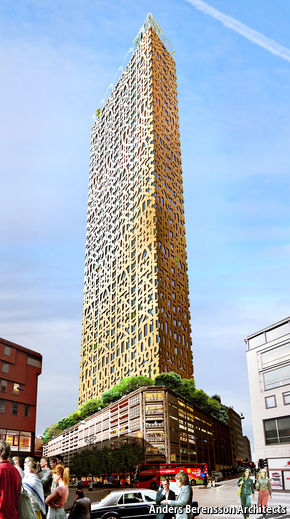
In an age of steel and concrete, the pagoda is a reminder of wood’s long history as a construction material. New techniques mean that wood can now be used for much taller buildings. A handful are already going up in cities around the world. The 14-storey Treet block of flats in Bergen, Norway, is currently the tallest. But Brock Commons, an 18-storey wooden dormitory at the University of British Columbia in Canada, is due to be completed in 2017. That is when construction is expected to begin on the 21-storey Haut building in Amsterdam. Arup, a firm of engineering consultants working on the project, says it will be built using sustainable European pine. Some architects have even started designing wooden skyscrapers, like the proposed Tratoppen (“the treetop” illustrated above), a 40-floor residential tower on the drawing-board in Stockholm.

Timber!

Wood has many attractions as a construction material, apart from its aesthetic qualities. A wooden building is about a quarter of the weight of an equivalent reinforced-concrete structure, which means foundations can be smaller. Timber is a sustainable material and a natural “sink” for CO2, as trees lock in carbon from the atmosphere. Tall steel-and-concrete buildings tend to have a large carbon footprint, in part because of the amount of material required to support them. Using wood could reduce their carbon footprint by 60-75%, according to some studies.

There are two main concerns about using wood to build high. The first is whether wood is strong enough. In recent years there have been big advances in “engineered” wood, such as cross-laminated timber (CLT) made from layers of timber sections glued together with their grains at right angles to one another. In much the same way that aligning carbon-fibre composites creates stronger racing cars, aircraft and golf clubs, CLT imparts greater rigidity and strength to wooden structures.

A recent experiment by Skidmore, Owings & Merrill, a firm of architects, and Oregon State University, shows how strong engineered wood can be. The researchers used CLT in a hybrid form known as concrete-jointed timber. This featured an 11-metre wide CLT floor section with a thin layer of reinforced concrete spread across the surface. Thicker sections of concrete were added where the floor was supported by pillars. It was put into a giant test rig where a powerful hydraulic press pushed with increasing force onto the surface. The researchers wanted to see how the structure moved under load, but kept pressing in order to find its limits. The floor finally began to crack when the load reached a massive 82,000 pounds (37,200kg), around eight times what it was designed to support.

The concrete covering the floor was mainly for sound insulation, but it helps to deal with the second worry: fire. The concrete adds a layer of fire protection between floors. In general, a large mass of wood, such as a CLT floor, is difficult to burn without a sustained heat source—for the same reason that it is hard to light a camp fire when all you have is logs. Once the outside of the timber chars it can prevent the wood inside from igniting. The big urban fires of the past, such as the Great Fire of London, which occurred 350 years ago this month, were mostly fuelled by smaller sections of timber acting as kindling. Prospective tenants would doubtless need lots of reassurance. But with other fire-resistant layers and modern sprinkler systems, tall wooden buildings can exceed existing fire standards, reckons Benton Johnson, a project leader with Skidmore, Owings & Merrill.

He says the test showed that not only can wood be made strong enough for tall buildings but that “it makes sense to use it”. Although a cubic metre of concrete is cheaper than an equivalent volume of timber, wooden buildings can be built faster. Mr Johnson thinks the appeal of wood, both visually and as a sustainable material, will make it commercially attractive to property developers.

blank
London’s tree house

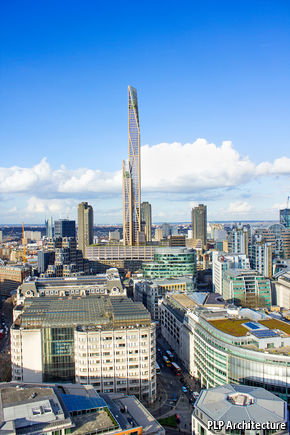
What about woodworm and rot? “If you don’t look after it, steel and concrete will fail just as quickly as timber,” says Michael Ramage, head of the Centre for Natural Material Innovation at the University of Cambridge in Britain. Dr Ramage and his colleagues are also testing wooden materials for tall buildings, including for an 80-storey, 300-metre wooden skyscraper (see illustration) presented as a conceptual study to the City of London. Designed with PLP Architecture and Smith and Wallwork, an engineering company, it would, if built, become the second-highest building in London after the Shard.

For a busy city such as London, there are yet more advantages to building higher with timber, adds Dr Ramage. For a start, the construction site would be a lot quieter without the heavy plant required to pound deep foundations, pump concrete and install steel supports. There would also be less construction traffic. Dr Ramage calculates that for every lorry delivering timber for a wooden building, five lorries would be needed to deliver concrete and steel. All these things may mean that once the total construction costs are calculated, a wooden building can work out cheaper.

Anders Berensson, the Swedish architect who designed Tratoppen, believes engineered wood will become the cheapest way to construct tall buildings in the future. Another benefit of the material, he says, is the ability to carve the wood readily. In his current design the number of each floor is cut into the building’s exterior.

One big obstacle to this wooden renaissance is regulation. Building codes vary around the world. In America cities can restrict wooden buildings to five or six storeys (about the height of a fire engine’s ladder). Exemptions can be made, however, and proponents of wood are hoping that as taller timber buildings emerge, city planners will adjust the rules. If they do, an old-fashioned branch of architecture might enjoy a revival.

More

×