Chris Ware: Drawing is Thinking

Chris Ware Exhibition at CCCB Drawing is Thinking

Chris Ware is one of the most innovative artists in modern comic books. His drawings touch us because they deal with human existence with great depth. The exhibition reviews the work and artistic thinking of a central cartoonist.

Chris Ware (Omaha, Nebraska, 1967) has been drawing—or, as he says, writing with vignettes—since he was small. Ware has experimented and innovated with comic book language and narrative throughout his life: from sketchbooks, to the iconic frontpage covers of The New Yorker, to his three essential works: Jimmy CorriganBuilding Stories and Rusty Brown.

© Chris Ware

The exhibition invites us to take a chronological look at the work of a master of the comic strip, with original pieces, animations, objects and sculptures, highlighting Ware’s invention of language.

“Chris Ware. Drawing is Thinking” invites us into the creative universe of a meticulous, artisan, emotional artist, influenced by the origins of the comic book, ragtime music and architecture, who has brilliantly narrated human emotions, racism, consumerism and the effects of politics on everyday life. For Ware, “drawing is a way of thinking”, because drawing connects us with thought and memory.

Building a Comic-Book Story Set in Barcelona

The exhibition concludes with a collective creation space inspired by one of Chris Ware’s most iconic works, Building Stories, transferring the story to Barcelona. A huge storyboard of blank vignettes covers the walls. Anyone can draw actions, memories, dreams or details in them and take part in the construction of a story based on Ware’s techniques. A proposal of La Gossa comic school (Alfredo Borés and Berta Embún), with contributions by cartoonists Cristina Daura, Nadia Hafid, Sergi Puyol and Marc Torices.

The space also has a reading and rest area, and a library with a  selection of works by Ware and other works that have influenced him.

“Chris Ware has the ability to activate the reader’s gaze and give them a kind of superpower they didn’t know they had.”
Jordi Costa

Curators: Jordi Costa

Participants: Chris Ware, La Gossa
MORE


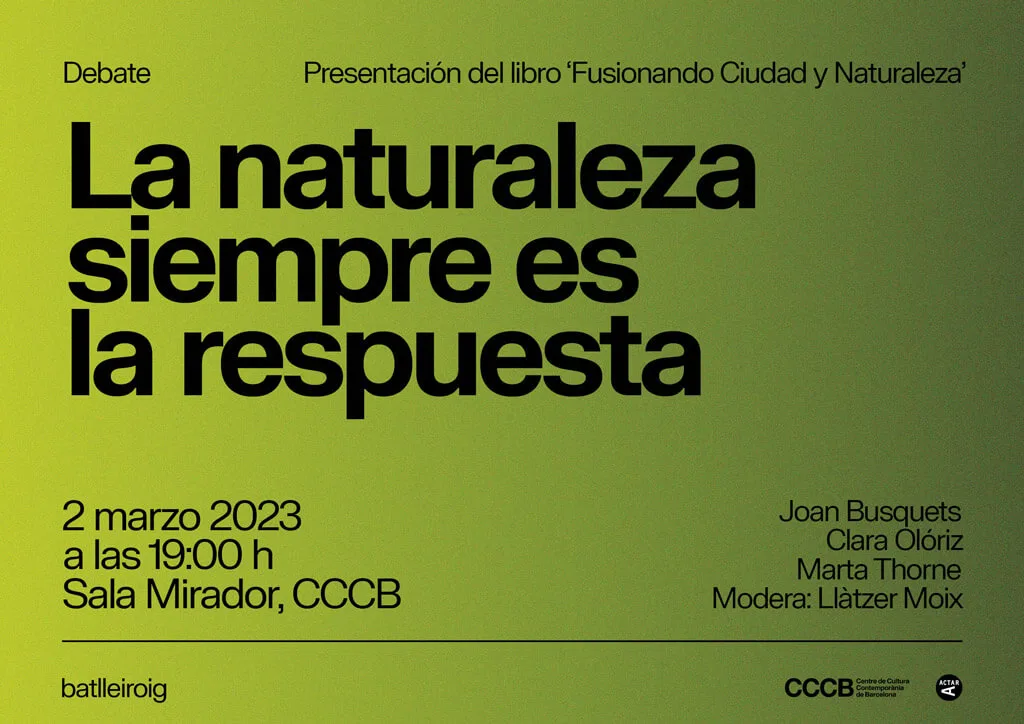
Presentación del libro ” Fusionando ciudad y naturaleza” de Batlle i Roig

‘Fusionando Ciudad y Naturaleza’ ha sido el propósito que Batlle i Roig ha tenido a lo largo de sus 40 años de trayectoria. Para celebrarlos, publica el libro “Fusionando ciudad y naturaleza”, un manifiesto de acción profesional contra la emergencia climática, explicado a través de algunos de sus proyectos más relevantes.

El próximo 2 de marzo tendrá lugar en la sala mirador del CCCB la presentación del libro del estudio de arquitectura Batlle i Roig con un debate con tres arquitectos que, desde la óptica de la Academia, también han participado en el libro. Con ellos reflexionaremos sobre por qué la naturaleza siempre es la respuesta.
blank

Los arquitectos Joan Busquets, profesor de la Harvard University, Clara Oloriz, investigadora y profesora de la Architectural Association y Martha Thorne, profesora distinguida de la IE School of Architecture and Design reflexionan, en un debate conducido por el periodista Llàtzer Moix, sobre cuál es el papel de la arquitectura ante los principales retos de la emergencia climática y de la necesidad de mejorar las condiciones de vida del planeta.

Hoy en día es inconcebible proyectar un edificio sin pensar cuál será su comportamiento hidráulico, climático o biofílico. Es la única forma de respetar las estructuras del lugar y, por lo tanto, de relacionarse empáticamente con el entorno. Y es bajo esta premisa, la de la empatía, que los y las arquitectas tienen el compromiso de trabajar con la naturaleza y para la naturaleza, como agentes transformadores de la ciudad y el territorio.


Rogamos confirmación de asistencia a [email protected]
Jueves 2 de marzo de 2023 – 19:00 h
Sala Mirador del CCCB Montalegre 5, 08001 Barcelona

MORE

Debates in the context of the Spanish Biennial of Architecture and Urbanism.

Living Together: Territory, Community, Resources

The XV Spanish Biennial of Architecture and Urbanism (BEAU) and the CCCB are organising three days of debates and seminars to reflect on the future of the territory and its resources, community life and the current challenges facing urban thought.

blank
What can we do to keep a territory alive, to unite a community? The 15th edition of the Spanish Biennial of Architecture and Urbanism focuses on the need to recalibrate the balance between more and less densely populated areas of our territory, while guaranteeing the well-being of the communities there. In an increasingly urbanised world, we will discuss proposals aimed at revitalising, in a coherent and respectful way, the densest urban areas as well as the most uninhabited territories – which are responsible, in turn, for providing our cities with food, materials and basic resources for their subsistence. The debates will also include reflections on the disruptions and transformations that have accelerated as a result of the pandemic, and which have necessarily led us to reconsider how we should design cities going forward.

During three days of debates and seminars, professionals, activists and researchers from different disciplines will share their experiences and engage in a dialogue with the public in order to reflect on their practices and present proposals that contribute, from the fields of architecture and urbanism, to a more egalitarian and balanced social model that is truly respectful of the spaces we inhabit.

blank

Building Communities Seminars in the context of the Spanish Biennial of Architecture and Urbanism 13 September 2021

How can we spark a dialogue between architecture and people’s desires and needs? With Paloma Strelitz and Cristina Goberna we will look at participatory practices and processes that promote the social function of architecture and urbanism.

Balancing the Territory Seminars in the context of the Spanish Biennial of Architecture and Urbanism 14 September 2021

Striking a balance between the more and less populated areas of the territory in a scenario marked by the effects of the pandemic and the energy crisis will be the focus of this dialogue between José María Ezquiaga, Maria Buhigas and Ricardo Devesa.

blank

City and Resources Seminars in the context of the Spanish Biennial of Architecture and Urbanism 15 September 2021

With Sébastien Marot, Xavier Monteys and Anna Bach we will rethink the connections between the countryside and the city, as well as the future of production and supply models for food and resources.


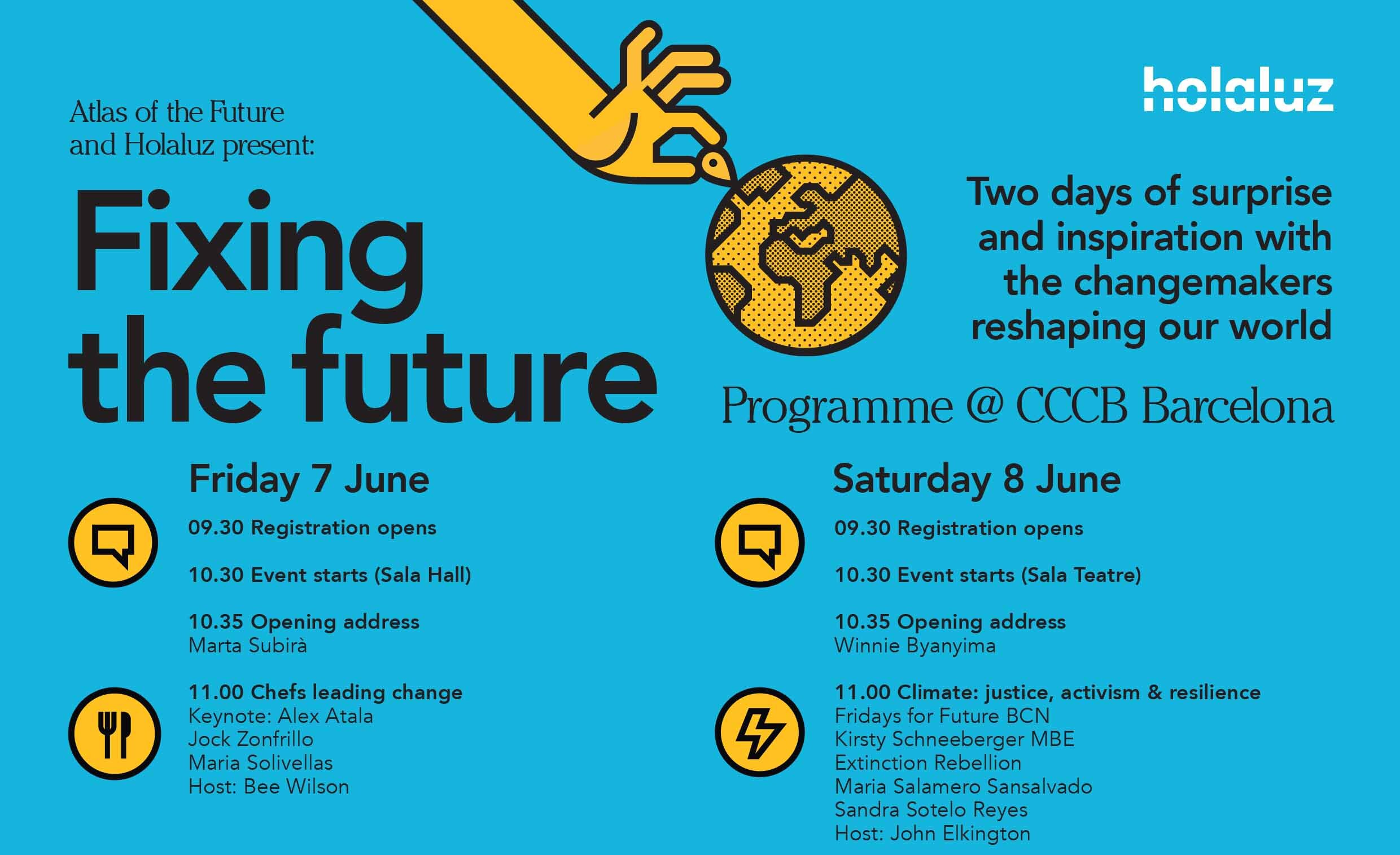
Fixing the future event at CCCB 7th and 8th of June

Fixing the future: Are you a future curious?

Organized by Atlas of the Future, Fixing the Future is back. And this year it’s bigger, better and faster – because the future can’t wait!

After 2018’s sold out event in Barcelona, Fixing the Future will return on the 7th and 8th of June at the CCCB with more than 40 Future Heroes from around the world. This time they’re helping fix biodiversity, our oceans, food and farming, cities and the climate crisis.

From rockstar chefs and a big wave surfer to visionary architects and the youth sparking a worldwide movement: you can expect stories of people doing things very differently.

Among them, the “City Reinvertor” Areti Markopoulou and the “Future City Prototyper” Vicente Guallart will tell us how to solve the audacious goals of our planet with radical methods.

blank


Here you have 3 of the most important speakers!

Global women’s rights leader and climate activist: Winnie Byanyima:

The Executive Director of Oxfam International is a women’s rights leader and authority on tackling climate change. Winnie previously led the directorates on gender and development at the UN Development Program and the African Union Commission, and served eleven years in the Ugandan Parliament. She co-founded the 60-member Global Gender and Climate Alliance.

blank

Photo: Bruno Bierrenbach Feder / Oxfam

Urban visionary: Carolyn Steel

A leading thinker on food and cities, Carolyn was profiled by The Ecologist magazine as a “21st Century Visionary”. With reason. The London-based architect, lecturer, BBC presenter and TEDGlobal speaker coined ‘Sitopia’ – now a widely-recognised way of seeing the world through the lens of food – and her ‘Hungry City: How Food Shapes Our Lives’ was BBC Food Programme book of the year. What lessons can we learn from the past?

blank

Book jacket

Godfather of modern sustainability: John Elkington

As a pioneer of the global sustainability movement for over 30 years (before the concept was even born), the prolific author and founder of corporate advisors Volans created the well-loved ‘Triple bottom line‘ (People, planet, profit) strategy for responsible business. His next step: launching an exponential call to arms.

blank

Meet all the speakers Here!

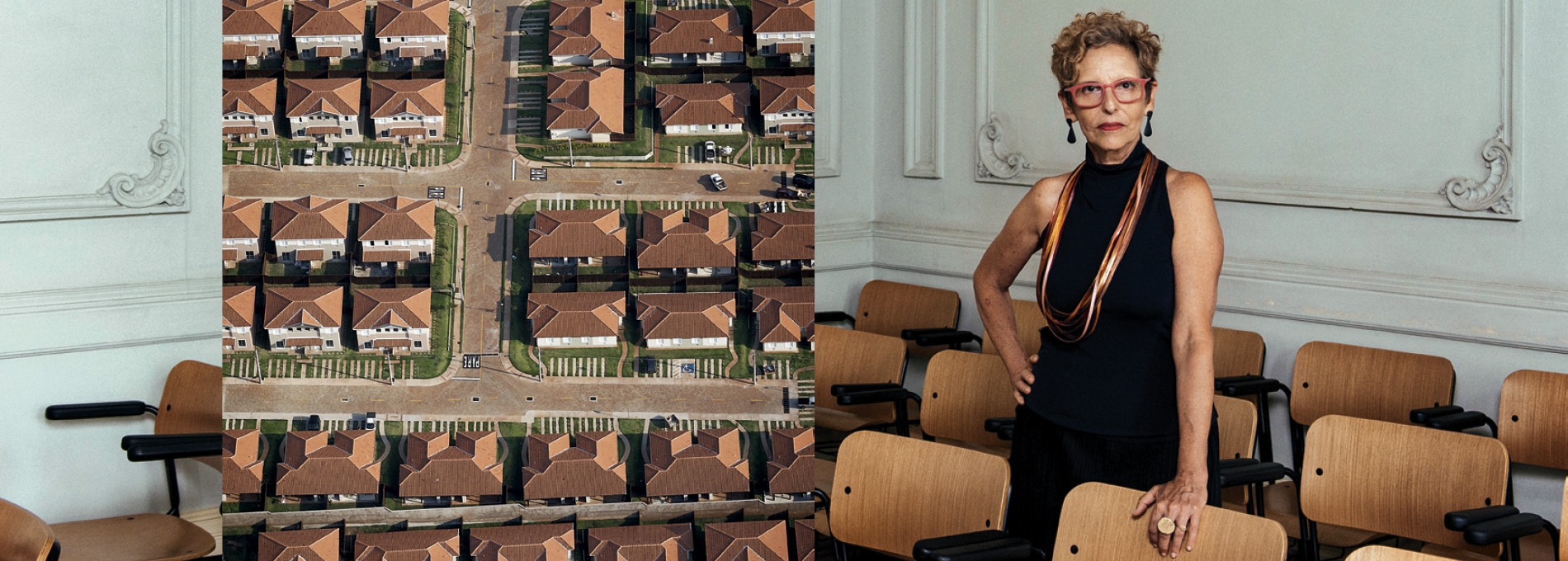
Raquel Rolnik Lecture at CCCB: Cities in the Hands of Global Finance

Lecture by Raquel Rolnik presented by Joan Subirats

Is the advance of global finances in the cities a threat to democracy? Raquel Rolnik, chair professor of the University of São Paulo and ex-secretary of Urban Programmes of the first government of Lula da Silva in Brazil, analyses the transformation of cities in the age of financial capitalism and considers why fundamental political values such as dissent and heterogeneity are being left outside the urban space. The lecture is presented by Joan Subirats, chair professor of Political Science at the Autonomous University of Barcelona (UAB).

blank

Cities and territories all over the world are increasingly colonized by the empire of global finance, and in this takeover of urban policy by finance, technologies such as big data and the concept of smart cities have a central role. The effects are not only economic and cultural, shaping new spaces and new ways of living in them, but mostly political, defining a post political era in each there is no space for dissention and heterogeneity.

Raquel Rolnik professor, architect and urban planner, with over 35 years of scholarship, activism and practical experience in planning, urban land policy and housing issues. She holds a professorial chair in the Faculty of Architecture and Urbanism at the University of São Paulo and is the author of several books and articles on urban and housing issues. In her career, she has held various government positions including Director of the Planning Department of São Paulo (1989-1992) and National Secretary for Urban Programs of the Brazilian Ministry of Cities (2003-2007), and has worked for NGOs, for example, as the Urban Policy Coordinator of the Polis Institute (1997-2002). From May 2008, Raquel Rolnik was appointed by the UN Human Rights Council as UN Special Rapporteur on adequate housing for a six-year mandate, ending in June 2014. She is the author of many books, including “Guerra dos Lugares: A colonização da terra e da moradia na era das finanças” and “A citade e a lei” which focuses on the analysis of zoning law in São Paulo.

Joan Subirats (Barcelona, 1951), Professor of Political Science at the Autonomous University of Barcelona (UAB), specialises in public policy and social exclusion and also democratic management and innovation. He was director of the Institute of Government and Public Policy at UAB and has been a visiting professor at the universities of Rome-La Sapienza, Berkeley and Georgetown.

More

European Prize for Urban Public Space

The 25 Finalists for 2016.

PublicSpace

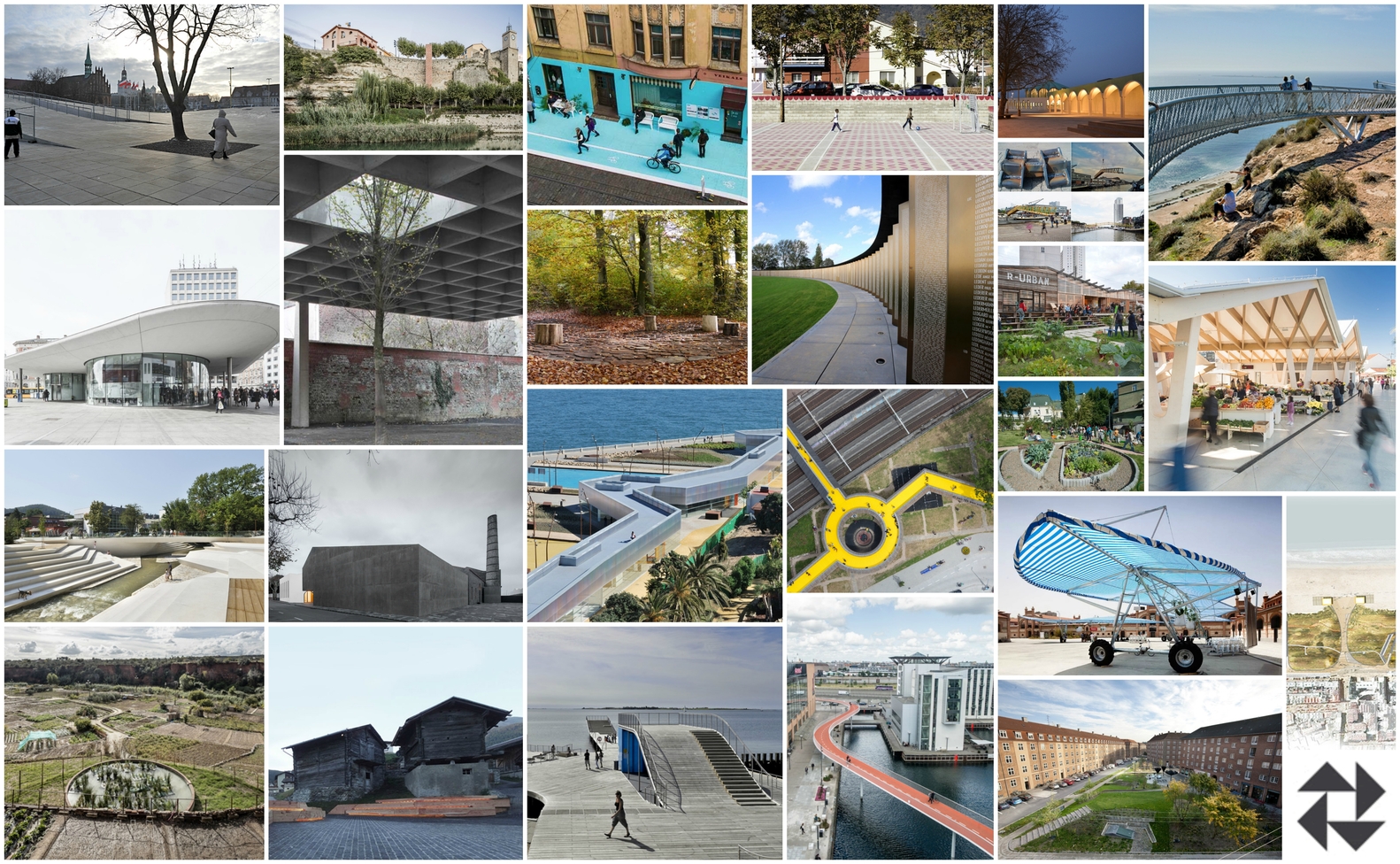
The Centre de Cultura Contemporània de Barcelona (CCCB) has announced the finalists for the 2016 European Prize for Urban Public Space. An international jury of architects, critics, and directors of museums and institutions from across the continent selected 25 projects from 276 entries representing 33 countries. According to the organization, “[the shortlisted projects recognize] the creation, recovery, and improvement of public spaces, as clear indicators of the democratic health of our cities.” All finalists will have their work featured in an exhibition that will tour Europe over the next two years, and also will be published in an online archive that features past finalists. The 2016 winner of the award will be announced at the CCCB on July 4.

Ring of Memory: International Memorial of Notre-Dame-de-Lorette Ablain-Saint-Nazaire, France, 2014

1

Temporary Bridge Over Charleroi Canal Brussels, Belgium, 2014

2

Wooden Benches in the Main Square Bürchen, Switzerland, 2015

3

Vantage Point and Protective Building at Genovese Park Cadiz, Spain, 2015

4

Recovery of the Irrigation System of the Spa Allotments Caldes de Montbui, Spain, 2015

5

R-Urban: Network of Urban Commons Colombes, France, 2014

6

Nørreport Station Copenhagen, Denmark, 2015

Remodeling of Tåsinge Square Copenhagen, Denmark, 2014

Cykelslangen Cycle Bridge Copenhagen, Denmark, 2014

Public Baths in the Harbor Fåborg-Midtfyn, Denmark, 2014

New Lift to the Historic Centre Gironella, Spain, 2015

7

New Coastal Defense Katwijk, The Netherlands, 2015

Garden of the Heavenly Hundred Kiev, Ukraine, 2016

Barkingside Town Centre Improvements London, UK, 2015

Escaravox Madrid, Spain, 2014

8

New Multiuser Porch Molenbeek-Saint-Jean, Belgium, 2015

Decoration of Sant Miguel Square Olot, Spain, 2015

10

Arquipélago, Contemporary Art Centre Ribeira Grande, Portugal, 2014

Silence! Riga, Latvia, 2014

Test Site Rotterdam, The Netherlands, 2015

Cycle Network Between Santa Pola and Alacant Santa Pola, Spain, 2015

9

Przełomy Centre for Dialogue in Solidarność Square Szczecin, Poland, 2015

Clearing in the Wood Uster, Switzerland, 2014

Remodeling of the Promenada Velenje, Slovenia, 2014

Fish Market Vodice, Croatia, 2015

(All images courtesy of European Prize for Urban Public Space)

Find out more about the prize on the CCCB’s Public Space website, here.


×