Bosch Capdeferro + Anna & Eugeni Bach Lecture


IAAC Lecture Series 2019/20 “Panel Presentation” by Bosch Capdeferro + Anna & Eugeni Bach. This year, three special events will aim to give an overview on the Catalan architectural scene, by presenting six local firms with a special focus on three themes: Regeneration, Urbanism and Ecology.

In 2003, Ramon Bosch and Bet Capdeferro founded the Bosch Capdeferro studio in the city of Girona. Since then, they have been working on projects of different scales and typologies, mainly focused on the relationship between man and the environment. Their professional activity has been developed in parallel to their teaching role at the Escola Tècnica Superior d’Arquitectura de Barcelona – UPC BarcelonaTech, the ETH of Zurich and at the Cornell University of New York, in the fields of theory and research and on the development of design and construction processes.

Anna & Eugeni Bach is a Finnish-Spanish team based in Barcelona working within a broad concept of architecture. Their interests spread across four activities: Professional, through public and private projects; Teaching, as professors at ETSAB UPC, ETSALS URL and EINA UAB, and via lectures and workshops in different European universities; Research, as PhD Candidates at ETSAB university and via projects and installations that deal with the perception of space; and Culture, where they are active in the boards of different associations that promote the values of architecture for society, as well as in curating exhibitions and lecture series.

12th of November 2019
Bosch Capdeferro + Anna & Eugeni Bach
Panel Presentation, Regeneration

@ 19.30, IAAC Auditorium
Free and Open to the Public

More

Anna & Eugeni Bach: Mies missing materiality

The incredible disappearing Mies van der Rohe Pavilion

by Anna & Eugeni Bach.

The Fundació Mies van der Rohe periodically invites artists and architects to provoke new looks and reflections through their interventions in the Pavilion. This year Anna & Eugeni Bach with The incredible disappearing Mies van der Rohe Pavilion: Mies missing materiality.

blank

After SANAA, Jeff Wall, Ai Weiwei, Enric Miralles, Andrés Jaque and Antoni Muntadas among others, this year Anna & Eugeni Bach will be in charge of transforming the Mies van der Rohe Pavilion with their project “mies missing materiality “.
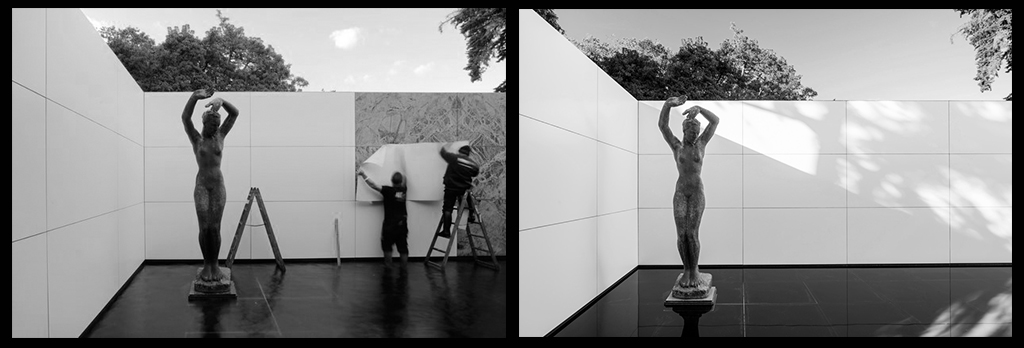
The artistic intervention will turn the Mies van der Rohe Pavilion into a real-size model for eleven days, dressing it with a unique material to undress it of all its materiality.

blank

On 8 November, the Pavilion began to lose its materiality and is gradually turning into a mock-up through an assembly performance involving the placement of white vinyl.

blank

“Dressing the Mies van der Rohe Pavilion to strip it of all materiality.

This simple act turns the Pavilion into a 1:1 scale mock-up, a representation of itself that opens the door to multiple interpretations about aspects like the value of the original, the role of the white surface as an image of modernity and the importance of materiality in the perception of space.
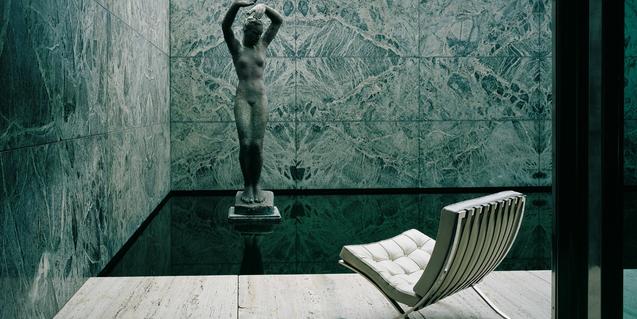
The Pavilion in Barcelona upon which we act is a reconstruction, a replica so faithful to the original that it is often difficult to remember its true nature. A building that should have been temporary was immortalised first by the written account of the modern movement and later by its own reconstruction.

blank

Turning the Pavilion into a mock-up, with all the surfaces restricted to the same material, as white as it is indeterminate, reveals the building’s representative role—both that of the original, as a national symbol, and that of the replica, by representing the former. For a time, the Pavilion will be the longest-standing 1:1 scale mock-up of the replica of the temporary pavilion in modern architecture.

blank

Removing all materiality from the Pavilion also raises other interpretations related to the historiography of 20th-century architecture.
The Pavilion in Barcelona was enthroned as an icon of modernity at the ‘Modern Architecture’ exhibition at the MoMA in New York in 1932. The exhibition catalogue presents various buildings by architects like Mies van der Rohe, Le Corbusier, Neutra, Wright, Oud, Gropius and others through a selection of photographs and critical essays in which Philip Johnson and Henry-Russell.

blank

Hitchcock indicate the homogenising criteria for combining all the works through the same lens. These include the white surface as an emblem of a new architecture, which appears as one of the most insistent.

To provide the Pavilion in Barcelona with that homogenising whiteness means to endow it with one of the defining features of modern historiography (not of modernity). Yet at the same time, it also involves stripping the Pavilion of its materiality and its unique characteristics—specifically the one that erected it as an icon of the modern movement.

blank

The installation turns this paradox into an experience. It helps visitors to consider these ideas and many more through their own experience in a pavilion that will lose all trace of its materiality for a few days to assume all its representative potential”. Anna and Eugeni Bach.

All images from ©Adrià-Goula
 

The incredible disappearing Mies van der Rohe Pavilion: Mies missing materiality

”Mies missing materiality”, an installation by Anna & Eugeni Bach in the Mies van der Rohe Pavilion.

Artists Anna and Eugeni Bach will carry out a creative intervention on the pavilion consisting of dressing it and then undressing it of all its materiality under the tittle “Mies missing materiality”.

The Mies van der Rohe Pavilion is a fantastic work of art. Walking around its facilities is always a rewarding experience, since its architectural conception offers us different sensations of space, colour, light, comfort and amplitude. As a construction, the Pavilion is of enormous interest, but it can also be understood as a blank page, a structure that allows us to conceive of new functions, new appearances and new languages.

blank

Every year, different international artists pass through the Mies van der Rohe Pavilion with a mission: to carry out a creative intervention on the structure that lends it a new physical and intellectual presence. November sees Anna and Eugeni Bach’s intervention called ‘Mies Missing Materiality’.

blank

19-20958

In the words of the artists, “The Mies van der Rohe Pavilion will be dressed to undress it of all its materiality. The Pavilion will, for a time, be the scale model 1:1 of the longest temporary pavilion of modern architecture”. After the work is unveiled – a process that will last for a week – we can visit it for another ten days, before the artists proceeed with its rematerialization, which means disassembling its new physical appearance so that the Pavilion can return to the its initial form. The first phase of the intervention is scheduled to take place from 8 to 15 November and it can be visited from 16 to 27 November. On 28 November the pavilion will go back to its original form.
If you want to find out more about this artistic intervention, you’ll find additional information at the following link.

×