Pavelló-Laberint, Ciro Najle + Josep Ferrando
Pavelló-Laberint (Pavilion-Labyrinth) constructs, on the travertine podium of the Barcelona Pavilion (Ludwig Mies van der Rohe, 1929), a glass labyrinth that reawakens and unfolds the latent tension of Miesian space, in which transparency materializes, with unsettling precision, the thicknessless boundary. The massless surface and limitless space are constituted as a liminal space-mass.
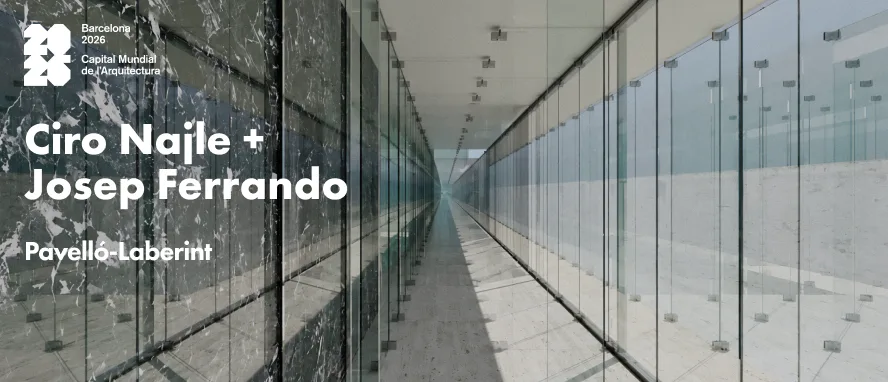
The flat pane of laminated glass, superficial, exact, conventional, impermeable, extends the Pavilion’s condition as the construction of a non-shelter and intensifies the idea of an architecture that rigorously exposes its fragility. Transformed into a Labyrinth, the Pavilion takes the anti-enclosure to the extreme at which lightness and transparency become density and opacity.
The saturation of the layout of open dividing planes multiplies and saturates the experience of the boundary until it becomes an absolute, omnipresent, and exclusionary state. The ambiguity between interior and exterior is superseded by the ambiguity between presence and disappearance: habitable space fades away even as the presence of space as an object intensifies.
Each segment functions as a pause suspended in the continuous air, now fully constructed and rarefied. It is a geometric inflection that locally disrupts perception while globally contributing to an alteration of the very idea of architectural space, which mutates from void to solid, from light to impalpable, from continuous to impenetrable, from universal to inevitable.
Pavelló-Laberint entails a strict economy of means that generates an open ecology of ends: a simple, delimited material within an inscrutable and infinite order. The Miesian plan folds back upon itself and vibrates, generating a spectrum of readings that link transparencies, reflections, transparencies of reflections, and reflections of transparencies.
Glass reveals a paradoxical condition as a wall, simultaneously exposing and concealing, orienting and disorienting, connecting and obstructing. Each fold multiplies uncertainty, and the horror of the void as a logical or conceptual dilemma becomes an awareness of fullness as a concrete tragedy. Instability, fragility, and estrangement become order, viscosity, and entanglement.
The regular grid of the travertine podium, the original pre-inscription, remains as the ground but is reconstituted as the volatile palimpsest of a hieroglyph that speaks an unknown language. The labyrinth functions as a layer that, while leaving its substrate untouched, distorts and corrupts its regularity. The labyrinth literally interprets the Pavilion, making its silence scream.
Between anti-tectonic precision and anti-critical transformation, and through the extreme intensification of the Miesian canon, Pavelló-Laberint proposes an architectural form of transparency that, through saturation, transcends the modern illusion of neutrality, homogeneity, and generality. And the myth of the void becomes absolute fullness and white noise.
Date 12.11.2026 to 22.11.2026